Get AI call notes into your EHR without writing code
The write-back actions verified today for athenahealth, eClinicalWorks, Open Dental and Dentrix, the CRM routes for calls that don't belong in a chart, and who actually builds the workflow.
| Greetmate
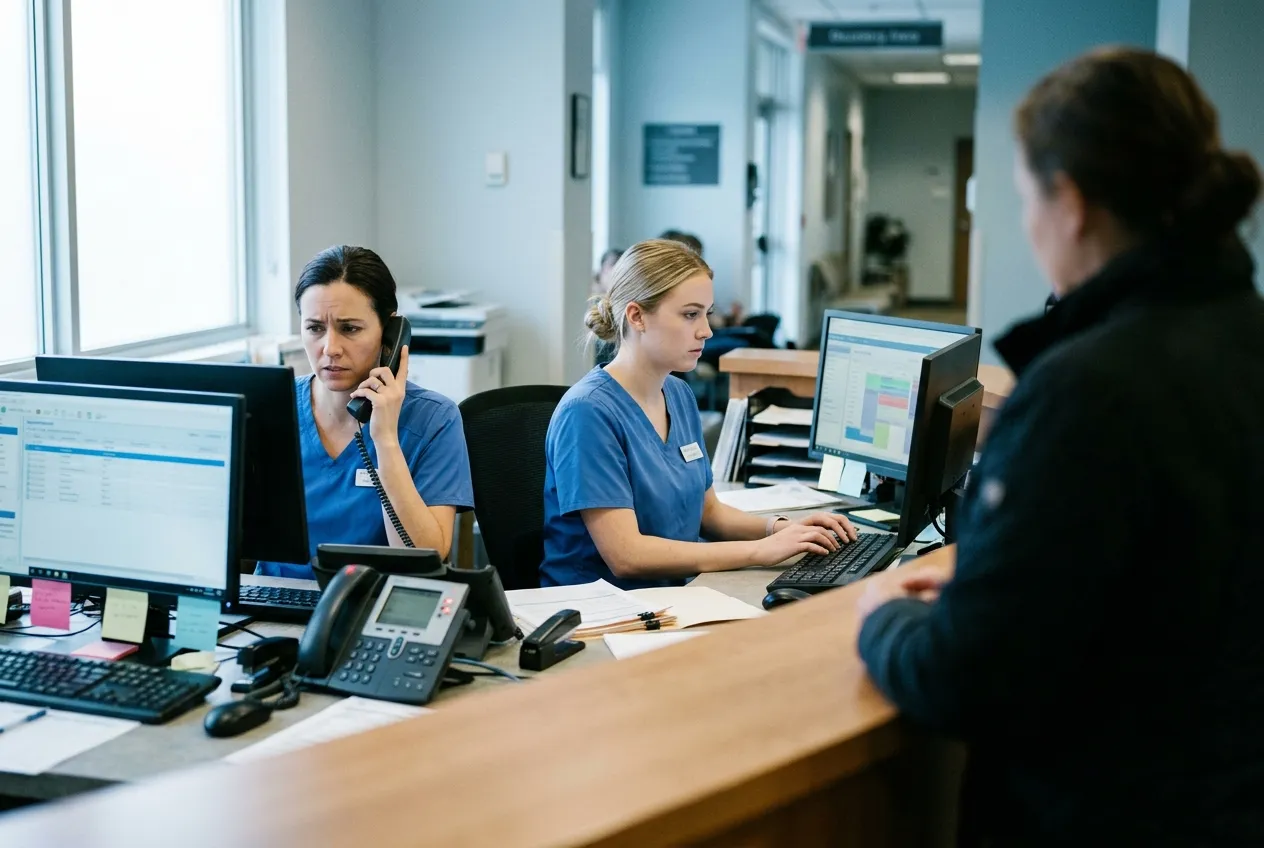
It's 8:47 AM on a Monday. Two front desk staff are already behind. One is on hold with an insurance carrier. The other is checking in a walk-in while fielding a rescheduling call. The phone rings again. Nobody answers. Somewhere in that missed call is a new patient who found your practice online over the weekend. They won't call back.
This is front desk overload — and if you run a growing medical practice, you've either lived it or you're heading toward it. The instinct is always the same: hire another person. But the practices that actually scale past this point aren't the ones that added a third receptionist. They're the ones that stopped treating this as a staffing problem.
Front desk overload is a workflow scalability problem. The structure underneath your front office wasn't designed for the call volume, the task complexity, or the multi-location consistency that practice growth demands. No amount of hiring fixes a broken architecture. This post explains why — and what fixing it actually looks like.
Table of Contents
Before diagnosing the cause, it helps to be specific about what your front desk is actually doing — simultaneously — on any given morning.
At a 4-provider practice handling roughly 200 inbound calls per day, a single front desk staff member is expected to:
None of these tasks are optional. All of them are happening at the same time. And the moment the phone rings during a face-to-face patient interaction, something breaks — the call, the patient experience, or the staff member's ability to do either well.
According to data from MGMA and compiled industry sources, a 4-provider practice fields roughly 200+ calls per day. A 10-provider group can see 300–500 daily. Each provider generates approximately 66 minutes of phone call overhead per day — and the vast majority of that overhead lands on the front desk, not the clinical team.
The result is what operations leaders increasingly call the task stack: a simultaneous, competing pile of administrative demands that no individual — regardless of their work ethic or training — can reliably clear without something falling through.
The front desk task stack isn't a performance problem. It's a structural one. When a staff member is expected to answer phones, check in patients, process paperwork, and respond to provider requests all at once, something always falls through the cracks — not because of who they are, but because of how the workflow is designed.
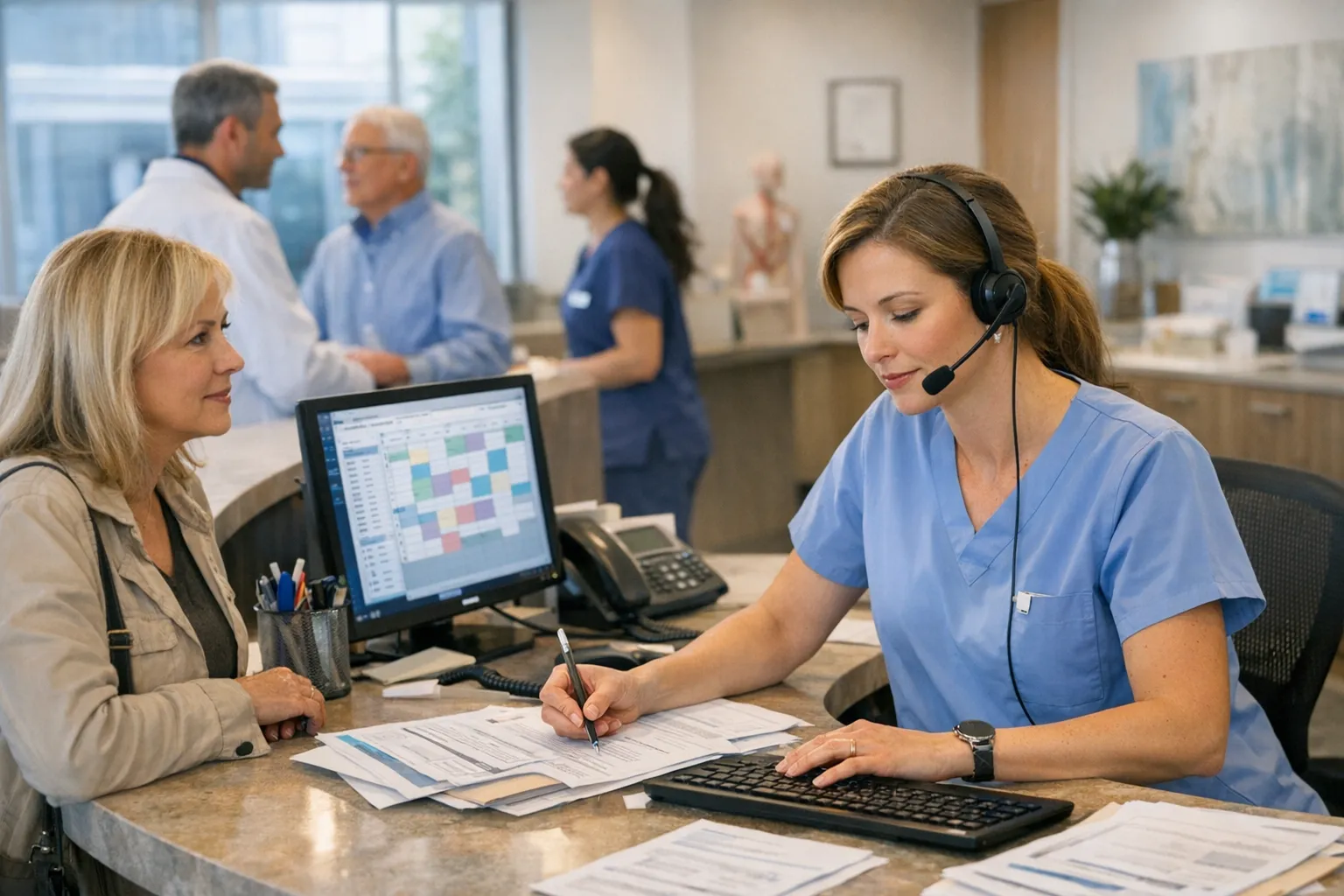
The default response to front desk overload is a job posting. And it's understandable — if the problem looks like "not enough hands," the solution looks like "more hands." But two compounding dynamics make this approach expensive, slow, and ultimately insufficient.
Healthcare front desk roles have an administrative staff turnover rate of 18.9% annually. That means roughly 1 in 5 of your front desk staff will leave this year. Replacing one of them costs up to $76,000 when you factor in recruiting, onboarding, and the productivity gap during the 45–60 days the seat sits empty.
Meanwhile, 47% of practice leaders say medical assistants — who frequently carry front-desk responsibilities — are the single hardest role to recruit. You're spending $76,000 to replace a role that takes two months to fill and will likely turn over again within the year.
The burnout dynamic compounds this further. Non-clinical administrative staff report a 45.6% burnout rate, and work overload increases that risk by up to 2.90x. You hire to relieve the overload. The new hire arrives into an already-overloaded environment. They burn out. They leave. The cycle resets — at $76,000 a turn.
The Cost of Front Desk Turnover
Here's the deeper structural issue: staffing scales linearly. Workflows don't have to.
When a practice grows from 4 providers to 8, call volume roughly doubles. To maintain the same service level through headcount alone, you need to double front desk staff — with all the associated cost, management overhead, training time, and turnover risk that entails. At 12 locations, that math becomes operationally untenable.
Healthcare front desk turnover runs at 2x the national average, and for multi-location groups, the compounding effect is severe: 45–60 days to fill each position, 15–20% higher wages since 2020, and 62% of hiring managers reporting lower-quality applicant pools. Adding headcount doesn't build a scalable operation. It builds a more expensive version of the same fragile one.
If the problem isn't headcount, what is it? It's architecture.
The workflows most practices run today were designed for a different era: lower call volumes, simpler insurance requirements, single-location operations, and a labor market where experienced front desk staff were reliably available and relatively affordable. That era is over.
The structural gap shows up most clearly in two places.
The majority of inbound calls to a medical practice are operationally routine. Appointment scheduling and rescheduling. Prescription refill requests. Directions and hours. Insurance verification status. These calls don't require clinical judgment. They don't require a human decision. But they're consuming the same staff capacity as the calls that do.
Across all practice sizes and specialties, 23% of calls go unanswered — sent to voicemail, abandoned on hold, or disconnected. Practices lose an estimated $150,000+ annually to missed calls alone. And 85% of callers who reach voicemail never call back — meaning that missed call isn't a deferred appointment. It's a lost one.
The problem isn't that your staff aren't answering fast enough. It's that the workflow routes every call — routine or complex — through the same human bottleneck.
What Happens to Unanswered Medical Practice Calls
Eleven percent of all patient calls occur outside standard business hours. In most practices, those calls hit a voicemail box that gets checked the next morning — if it gets checked at all. Weekend calls account for 23% of total weekly call volume at practices with any after-hours coverage. Urgent care needs, Monday appointment scheduling, and follow-up requests don't stop at 5 PM.
This isn't a staffing gap. No reasonable practice is going to hire around-the-clock front desk coverage. It's a workflow gap — one that can only be addressed by designing a system that operates when your staff don't.
Explore how Greetmate handles overflow and after-hours coverage
Scaling a front desk operation doesn't mean more staff doing the same things faster. It means redesigning which tasks require a human at all — and building infrastructure that handles the rest consistently, regardless of call volume, time of day, or location count.
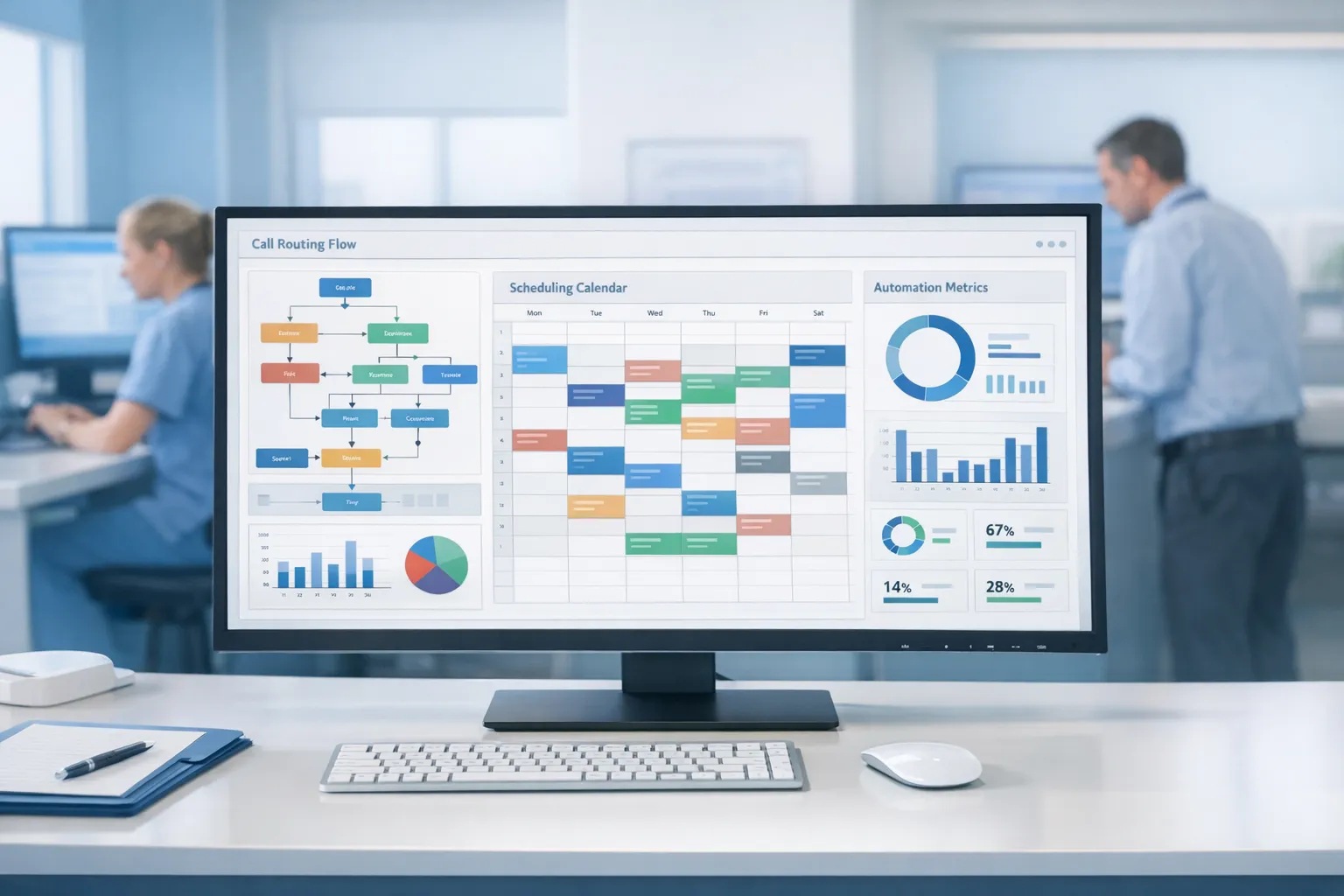
The distinction matters: automation as a feature is a single tool that saves a few minutes. Automation as infrastructure is a coordinated workflow layer that handles intake, routing, scheduling, confirmations, follow-up, and after-hours coverage — integrated into your EHR, your calendar, and your communication stack — and that operates without requiring staff to manage it in real time.
Greetmate is built as exactly that kind of infrastructure layer. Rather than offering a self-serve tool to layer onto an existing broken workflow, Greetmate's model is implementation-first: guided workflow design, white-glove onboarding, and direct integration with the EHR and scheduling systems the practice already uses — including athenahealth, Epic, Tebra, ModMed, eClinicalWorks, Dentrix, and 300+ other platforms. The result is a system that can handle roughly 70–80% of routine patient communication tasks, reducing front desk workload by approximately 35% or more — not by replacing staff judgment, but by removing the routine volume that was consuming it.
Basic deployments can go live within hours. The workflow design phase ensures that what gets automated actually reflects how the practice operates — not a generic template.
For multi-site groups, the workflow problem compounds in a specific way: every location is running a slightly different version of the same broken workflow. Call handling varies by site. After-hours coverage is inconsistent. Reporting is nonexistent or siloed. When a patient calls the wrong location, there's no standardized routing logic to get them where they need to go.
Workflow infrastructure solves this at the architecture level — not by training each site's staff differently, but by deploying consistent call flows, routing logic, and intake capture across every location from a single operational layer. For multi-location groups and MSOs, this is the difference between managing 12 individual front desk problems and managing one scalable system.
Reduce front-desk call volume and improve patient communication.
Go live in hours with done-for-you setup.
Most practices don't have clear visibility into their call operations — which makes it difficult to diagnose the real constraint. Here are five signals that point to a workflow architecture problem rather than a headcount problem:
1. Call volume spikes overwhelm the team even when fully staffed. If a fully staffed Monday morning still produces missed calls and hold abandonment, the workflow doesn't have enough capacity headroom. That's an architectural gap, not a staffing gap.
2. After-hours and weekend calls go to voicemail with no structured follow-up. If there's no defined workflow for what happens to an after-hours call — who sees it, when, and what triggers a callback — you have a workflow gap that no hire will fix.
3. Turnover resets your operational baseline every few months. If a staff departure meaningfully disrupts call handling quality, your operations are too dependent on individual tribal knowledge rather than documented, automated workflow. Institutional knowledge shouldn't live in a person's head.
4. You have no data on call outcomes. If you can't answer "how many calls did we miss last week, what were they about, and what happened to those patients," you have a visibility problem that compounds every other operational problem. Reporting and analytics are core to understanding where the workflow breaks down — and where automation can recover the most ground.
5. Scaling locations means proportionally scaling headcount. If your plan for opening a new location includes a line item for two more front desk staff, you're building a linear cost structure into a growth model that doesn't have to work that way.
For a deeper look at where the intake and scheduling workflow breaks down specifically, the analysis in Where Patient Intake Breaks Down (And How to Fix It) maps the specific failure points most practices don't track.
Watch for these red flags: If your practice experiences two or more of the five signals above on a regular basis, you're likely dealing with a structural workflow problem — not a staffing shortage. Each signal that goes unaddressed compounds the others.
Why is my medical front desk always overwhelmed, even with good staff?
Front desk overload is typically a workflow design problem, not a staffing quality problem. When routine, automatable tasks — scheduling, confirmations, intake capture, basic call routing — run through the same human channel as complex requests, the entire system operates at the capacity of its slowest bottleneck. Good staff can't compensate for a workflow that wasn't built to handle current call volumes.
How many calls does a typical medical practice receive per day?
Call volume scales with provider count. A 4-provider practice handles roughly 200+ inbound calls per day; a 10-provider group can see 300–500 daily. Each provider generates approximately 66 minutes of phone call overhead per day — the majority of which routes to the front desk.
What's the real cost of missed calls at a medical practice?
The average multi-physician practice loses over $150,000 annually to missed calls and abandoned hold times, according to Weave's 2025 Patient Communication Report. Individually, each missed call costs $125–$200 in lost appointment revenue — and 85% of callers who reach voicemail never call back.
Can automation actually reduce front desk burnout, or does it just shift the work?
Well-implemented workflow automation reduces the volume of routine tasks that generate the most operational fatigue — repetitive scheduling calls, manual confirmations, after-hours coverage gaps. When automation handles those tasks at the infrastructure level (integrated into the EHR, running consistent workflows, generating reportable outcomes), staff can focus on work that actually requires their judgment and presence. That's a meaningful reduction in the task stack that drives burnout — not a cosmetic one.
What's the difference between workflow automation and just adding a chatbot?
A chatbot is a feature. Workflow automation at the infrastructure level means the entire call handling architecture — routing logic, intake capture, scheduling integration, after-hours coverage, follow-up triggers — is designed, implemented, and maintained as a coordinated system connected to the practice's existing tools. The former answers a few FAQs. The latter replaces a structural bottleneck.
Front desk overload isn't going to resolve itself through another hire. The task stack is structural. The turnover cycle is expensive. And the call volume isn't going to decrease as your practice grows — it's going to increase.
The practices building durable, scalable operations are the ones that have stopped treating this as a people problem and started treating it as a workflow architecture problem. That means designing systems that handle routine call volume consistently, close the after-hours gap without adding headcount, generate real visibility into call outcomes, and scale across locations without a proportional increase in cost.
That's the operational shift that actually moves the growth ceiling.
If your front desk is the bottleneck in your growth model, the next step is understanding what a redesigned workflow would look like for your specific call volume, EHR environment, and location structure.
Book a discovery call with Greetmate to see how healthcare organizations are rebuilding their front office operations as scalable workflow infrastructure — not a staffing workaround.
Handle patient calls around the clock — including after-hours and overflow — so your front desk can focus on in-office care.
Automate appointment scheduling, patient follow-ups, and reactivation outreach through workflow-driven voice communication.
Connect with your existing EHR, scheduling tools, and operational systems for seamless, end-to-end patient communication.
See Greetmate in Action.
Healthcare voice AI infrastructure — live in hours.
Find helpful articles in our blog that are all about business, customer service and AI technology.
The write-back actions verified today for athenahealth, eClinicalWorks, Open Dental and Dentrix, the CRM routes for calls that don't belong in a chart, and who actually builds the workflow.
The healthcare version of missed call text back: an automated callback within sixty seconds, an SMS fallback, and a staff handoff, plus the TCPA and HIPAA rules the practice owns.