What makes an answering service HIPAA compliant? Checklist
A BAA is only the entry ticket. Here is what should actually be inside it, how PHI moves through texts and recordings, and ten questions to ask a vendor before you sign.
| Greetmate
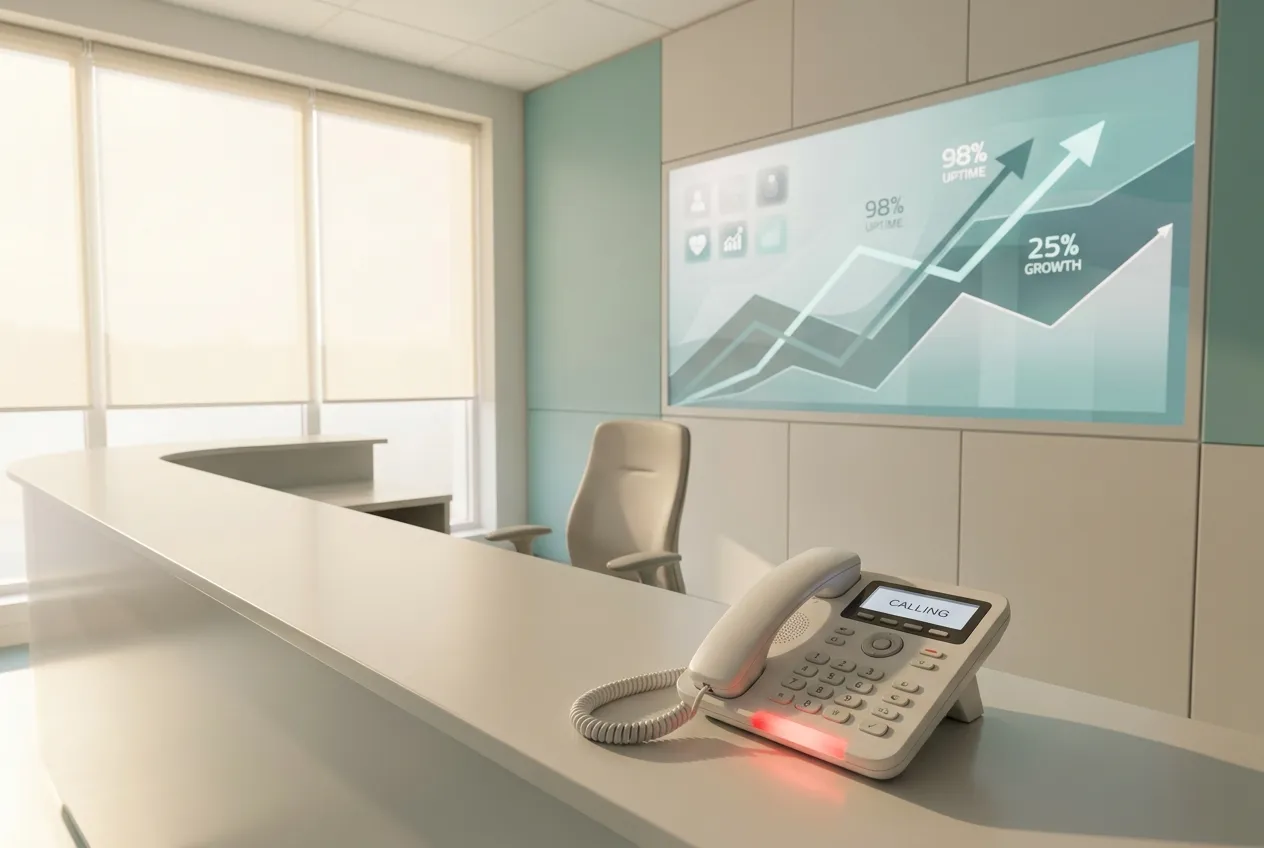
A patient calls your practice at 8:47 AM on a Tuesday. No one picks up. They leave a voicemail — or, more likely, they don't. They Google the next clinic in your specialty and dial again. By the time your front desk works through the voicemail queue at 11:30, that patient has already booked elsewhere. You'll never know they called. You'll never know what they were worth.
This is the quiet arithmetic of patient response time, and it is the single most underpriced operational metric in U.S. healthcare. The ROI of faster patient response times isn't a soft "patient experience" story — it's a hard P&L line item that touches new-patient revenue, marketing efficiency, schedule density, and long-term retention. Most practice leaders track no-show rates and collections to the decimal point but cannot tell you how many calls went unanswered last week, how long the average new-patient inquiry waited for a callback, or what those delays cost.
This article breaks down the actual math, the operational breakpoints where response time decays, and the levers that move the number — including where AI voice and SMS infrastructure changes the economics, and where it doesn't.
Table of Contents
Most administrators inherit "phone problems" as a service-quality complaint. The data says otherwise. Phone responsiveness shows up directly in three financial categories every CFO already tracks: new-patient revenue, marketing yield, and patient attrition.
On the revenue side, Invoca's healthcare call tracking data shows providers miss an average of 29% of inbound calls. One frequently cited study of 7,000 calls across 22 practices in 18 states found 42% of calls were missed during business hours. In dental, Peerlogic's 2024 analysis found 68% of calls go unanswered during peak hours.
On the marketing side, the math gets uglier. The same Invoca data pegs wasted healthcare marketing spend from missed calls at roughly $383,827 per month for organizations that invest heavily in patient acquisition. You paid to make the phone ring. Then no one answered it.
On attrition, the 2024 Global Benchmark Report on Healthcare Customer Experience found 66% of patients are likely to switch providers when communication fails their expectations — up 15% in a single year. For Millennials and Gen Z, that number climbs to roughly three-quarters.
Response time, in other words, is not soft. It is the moment at which marketing spend either converts or evaporates.

Speed-to-lead research outside healthcare has been settled for over a decade, and the pattern holds inside it. The original Lead Response Management Study (and a widely cited Harvard Business Review analysis built on top of it) found that contacting an inbound lead within five minutes yields 21x higher qualification rates than waiting 30 minutes. Velocify's analysis went further, showing that responding within one minute can lift conversion by 391%.
Healthcare-specific work mirrors this. A MyMedLeads study of thousands of plastic surgery leads found practices that called within 12 minutes converted ~65% of inquiries to consultations, those that called within an hour converted 31%, and those that called within nine hours converted just 8% — and the average medical practice took roughly nine hours to respond to form inquiries.
Translate that into dollars per missed interaction:
Now multiply by the access window. 41% of patient calls occur outside the standard 8 AM–5 PM weekday window, and only 19% of healthcare call centers operate 24/7. The "response time problem" is partly a coverage problem the front desk was never staffed to solve.
Curious what your practice is losing to delayed responses? Our breakdown of missed-call revenue math walks through the per-call and lifetime-value calculations side by side.
Patient Conversion Rate by Response Time
The ROI of faster patient response times is calculated by multiplying (additional captured calls per day) × (conversion rate to booked appointment) × (average first-visit value or patient lifetime value), then subtracting the cost of the response infrastructure. For a practice answering 20 additional calls per day at a 30% conversion rate and a $230 first-visit value, that's roughly $30,000 in additional monthly revenue — before factoring in marketing-spend recovery or downstream lifetime value.
Saying "respond faster" is not a strategy. To move the number, you have to know where the seconds and hours leak. Five breakpoints account for most of the loss:
Front desks are simultaneously checking in arrivals, verifying insurance, taking copays, and answering the phone. When all four happen at once, the phone loses. Healthcare call centers average a 4.4-minute hold time — well above the Healthcare Financial Management Association's 50-second benchmark, and 34% of callers abandon after just two minutes on hold.
Voicemail is not a safety net. 62% of patients hang up without leaving a message, and of those who do, the practice typically returns the call hours later — long past the window in which the patient is still actively choosing a provider.
Weekend calls represent roughly 23% of weekly call volume at practices with after-hours messaging, and many of those callers are planning Monday or Tuesday appointments. A practice that does nothing with weekend inbound is conceding two days of new-patient revenue every week.
This is the killer. Practices spend tens of thousands per month on paid acquisition and SEO to drive form fills, then take an average of 9 hours (medical practices) to 44 hours (hospitals) to respond. The five-minute "hot zone" closes long before anyone picks up the phone.
In groups of 5+ providers or multi-site organizations, response performance varies wildly by location. One office answers in 30 seconds; the office across town routes everything to voicemail by 11 AM. Without standardized routing, overflow, and reporting, leadership has no way to see — let alone fix — where the leak is.
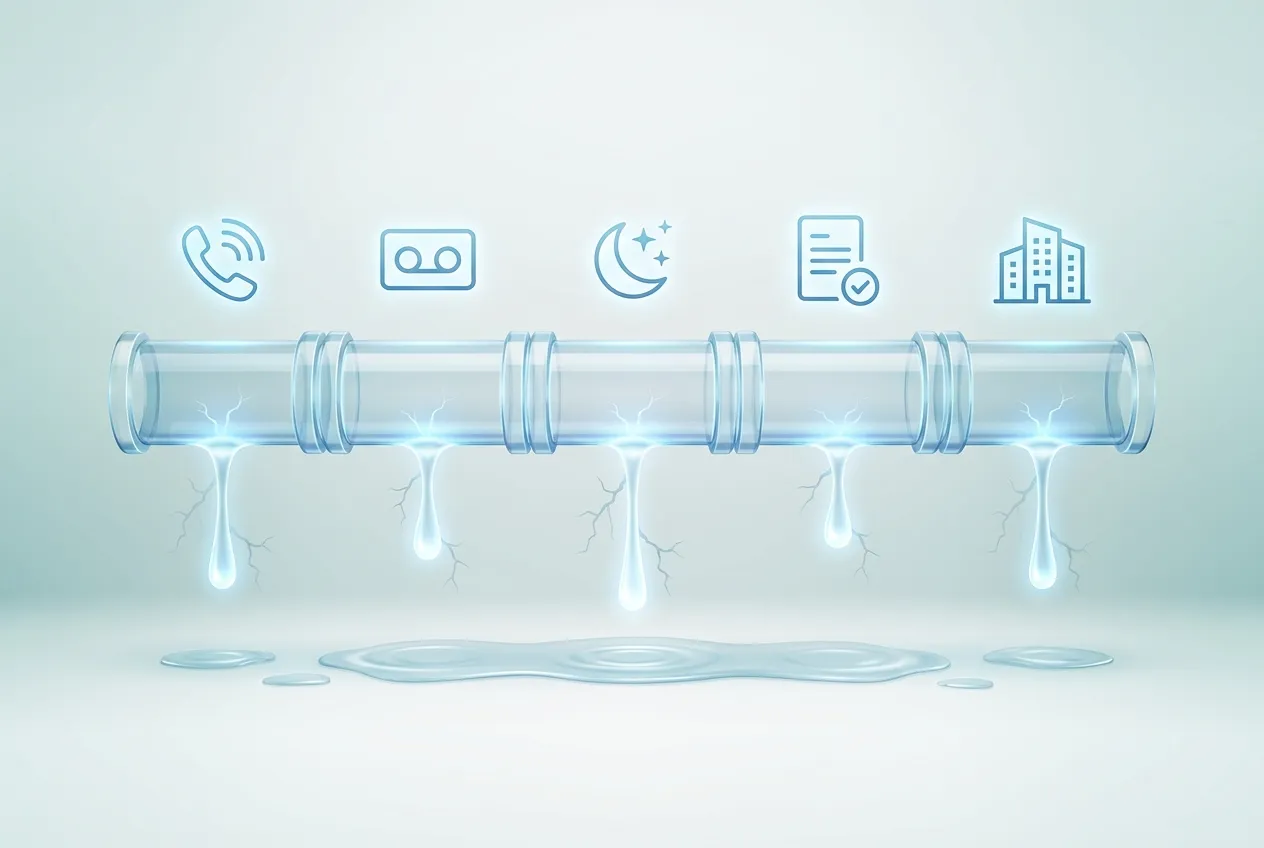
There are only a handful of mechanisms that meaningfully change response time at scale. Most practices try one and stall. Compounding requires layering several.
Overflow capture during peak hours. When the front desk is buried, calls have to go somewhere productive — not voicemail. AI voice answering, intelligent IVR with callback options, or a hybrid agent + AI model can absorb peak load and book directly into the calendar.
24/7 coverage for after-hours and weekends. Given that ~41% of calls fall outside business hours, this is where the largest pool of unrecovered revenue sits. AI voice and SMS infrastructure makes round-the-clock answering economically viable for practices that could never justify a 24/7 human team.
Sub-five-minute web-lead callback. Every web form submission should trigger an outbound voice or SMS within minutes, not the next morning. This is automation territory — humans cannot reliably hit a five-minute SLA across 80+ inquiries a day.
Two-way SMS as the default fallback. When a call can't be answered live, an automatic SMS that says "we just missed you — here's a link to book or a quick way to reply" recovers a meaningful share of otherwise-lost inquiries. 75% of missed callers never call back, but they will often reply to a text.
Standardized workflows across locations. Whatever you deploy has to work the same way at every site. Inconsistency is what turns a $200,000 problem into a $1.2M problem — multi-location groups average $1.2M in annual missed-call losses, and groups with 25+ locations can lose $3–6M.
Reporting that ties calls to outcomes. You can't manage what you can't see. Most practices have no idea how many calls hit voicemail last week, how many were never returned, or which marketing source those calls came from. Without that visibility, every other lever is operating blind.
Reduce front-desk call volume and improve patient communication.
Go live in hours with done-for-you setup.
Greetmate exists for one reason: the response-time problem above is not solvable by adding more humans to the front desk. The math doesn't work, the labor isn't available, and the variance across locations gets worse, not better, as you scale.
The Greetmate model is healthcare voice and SMS AI infrastructure delivered as a tech-enabled service — implemented, not just activated. That distinction matters here, because most of the operational levers above (callback SLAs, after-hours coverage, multi-location standardization, reporting) require workflow design and EHR integration, not just a phone number with a bot attached.
What that looks like in practice for a response-time program:
For most healthcare buyers, automating ~70–80% of routine patient communication tasks and cutting front-desk workload by ~35% is enough to turn the response-time line item from a liability into a recovered revenue stream — and to make ROI visible inside the first quarter.
If you want to see what that looks like for your practice's call volume, book a discovery call and we'll walk through the math against your actual numbers.

The widely accepted speed-to-lead benchmark is under five minutes for any new inquiry — voice or web form. Inside healthcare, top-performing practices target an answer-on-first-ring rate above 95%, hold time under 30 seconds, and callback on missed calls within minutes, not hours. The 9-hour average response time most medical practices currently operate at is well outside the conversion window.
It depends on call volume and specialty, but published estimates for a typical primary care practice run $200,000–$500,000 annually in lost revenue from missed and delayed calls, with high-volume specialty practices exceeding $1 million per year. Multi-location groups average roughly $1.2M, scaling with site count.
Yes — and the effect is dramatic. Healthcare-specific research has documented conversion rates of ~65% when leads are contacted within 12 minutes versus ~8% when contacted within 9 hours. Cross-industry speed-to-lead research shows 21x higher qualification when contact happens within 5 minutes versus 30.
In voice and SMS, AI infrastructure typically answers inbound calls in under a second and triggers automated outbound responses to web inquiries within minutes. Hitting a 5-minute SLA consistently with a human-only team across 80+ inquiries a day and after-hours volume is operationally and financially impractical for most practices.
Documented case studies in the space show practices achieving meaningful additional monthly revenue within the first 30–90 days of deployment, primarily driven by recovered missed-call volume and faster lead conversion. The ramp depends on call volume, conversion rate, and average visit or lifetime value.
Patient response time is not a customer-service initiative. It is the moment at which every dollar your practice has spent on marketing, real estate, providers, and staff either converts into revenue or walks down the street to a competitor. The data is unambiguous: the practices that respond fastest capture disproportionate share, lose less to marketing waste, and retain more of the patients they already have.
The constraint is operational, not strategic. Front desks cannot scale to a five-minute SLA across 24/7 demand, and human-only multi-location coverage cannot deliver the consistency the financial model requires. That's the gap AI voice and SMS infrastructure is built to close — not as a receptionist replacement, but as the operational layer that makes faster response economically and operationally real.
If you're sizing the ROI of a response-time program for your practice or group, the math starts with three numbers: how many calls you currently miss, how many of those were new-patient inquiries, and what those patients are worth. Greetmate can help you put real values on each — and design the workflows that turn the number around. Book a discovery call when you're ready to look at yours.
Find helpful articles in our blog that are all about business, customer service and AI technology.
A BAA is only the entry ticket. Here is what should actually be inside it, how PHI moves through texts and recordings, and ten questions to ask a vendor before you sign.
The vendor checklists cover training and demos, none of it checkable. Here are five things you can get in writing before the contract starts, with benchmark numbers to hold against.