6 Best AI Tools for Pain Management Practices in 2026
| Greetmate
Interventional pain management practices sit at the intersection of some of the most administratively brutal workflows in outpatient medicine: high-volume prior authorizations for injections and neuromodulation, complex procedural coding, chronic-pain patients requiring frequent follow-up, opioid documentation scrutiny, and inbound call volume that would break most front desks. The best AI tools for pain management practices in 2026 aren't the ones with the flashiest demos — they're the ones that plug into these specific pressure points and hold up under real operational load.
This guide ranks six categories where AI is actually moving the needle for pain practices this year: clinical documentation, specialty EHR, prior authorization, revenue cycle management, spinal imaging analysis, and voice/SMS front-desk automation. For each, we cover what the category solves, which vendor stands out for pain specifically, and what to watch for during evaluation. No generic "AI receptionist" fluff — this is an operator's shortlist.
Table of Contents
Why Pain Management Practices Have a Unique AI Adoption Problem
Before ranking tools, it's worth being specific about why pain management is different from primary care or general orthopedics when it comes to AI.
Three operational realities shape everything:
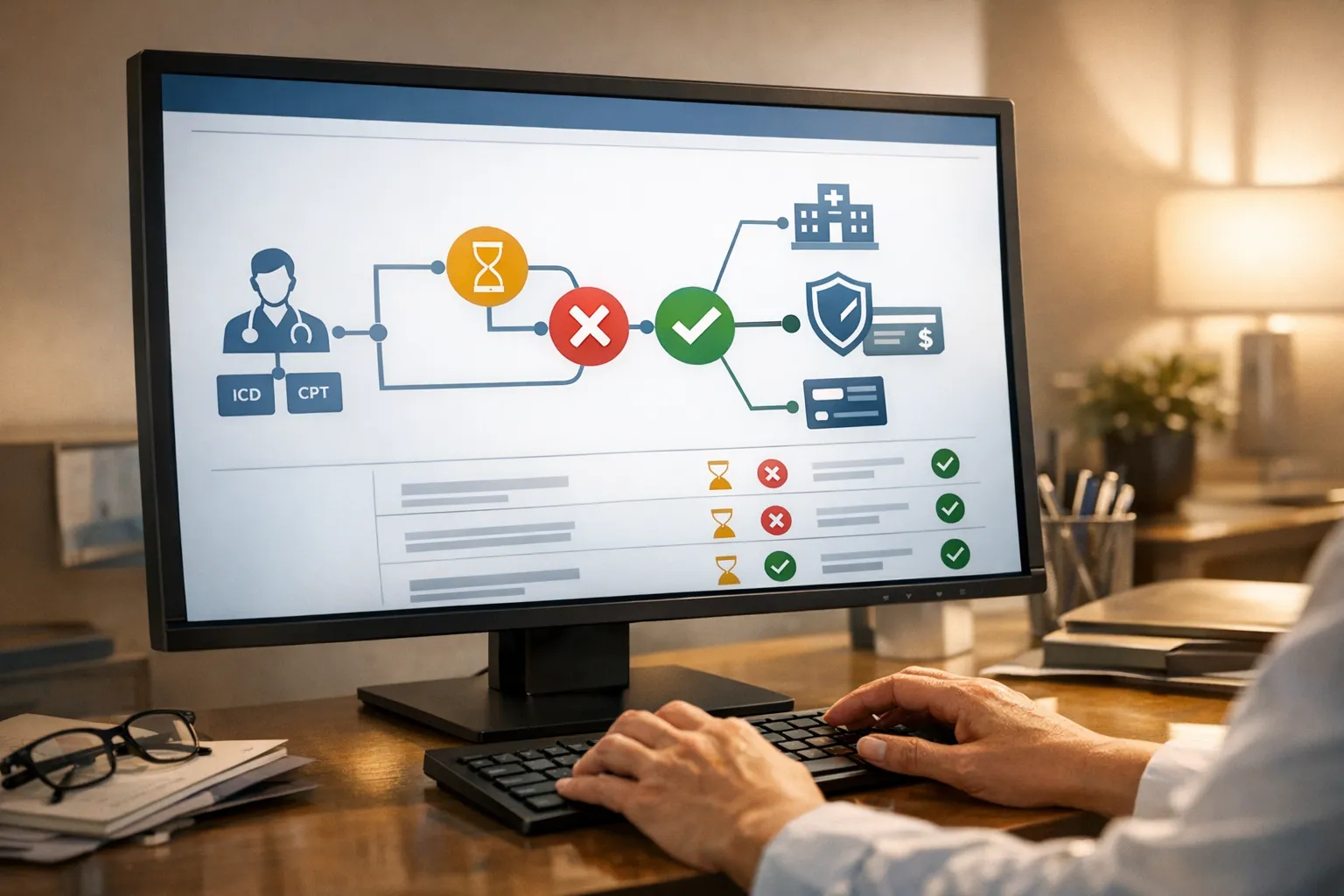
Prior authorization volume is off the charts. Physicians nationally complete an average of 39–40 prior authorizations per week and spend roughly 13 hours doing so, according to the AMA's 2024 physician survey. In interventional pain, where epidurals, radiofrequency ablations, spinal cord stimulator trials, and pump refills each carry their own PA requirements, the burden runs materially higher.
Coding complexity is severe. Interventional procedures blend E/M, procedure codes, fluoroscopic guidance, medication J-codes, and modifier stacking. One Texas pain practice profiled by AMS Solutions was running a 25% denial rate before restructuring its billing operation.
For pain specifically, ModMed's Scribe 2.0 stands out because it's built directly into EMA — an EHR ModMed maintains with a dedicated pain management specialty configuration. Ambient listening captures the encounter, generates a structured note, and pushes downstream orders and coding into the same system, so nothing has to be rekeyed between platforms. That matters more in pain than in most specialties, where a follow-up visit note directly drives the injection order, the fluoroscopy documentation, and the CPT/ICD-10 pairing that determines whether the claim clears.
Honorable mentions in this category include Nuance DAX, Suki, DeepScribe, Augmedix, Freed, and Heidi — all viable, but none purpose-mapped to interventional pain workflows the way EMA + Scribe 2.0 is.
What to evaluate: Does the scribe understand injection-site terminology (medial branch, transforaminal, sacroiliac)? Does it correctly pair fluoroscopic guidance codes? Does it write in your attending's preferred structure?
2. Specialty EHR — ModMed EMA (pain management build)
Category: Specialty electronic health record
Generic EHRs punish specialty practices. Pain management has enough procedural nuance — bilateral levels, laterality, contrast use, sedation, guidance modality — that a general-purpose ambulatory EHR forces heavy customization and free-text documentation that later trips up billing.
ModMed EMA offers a dedicated pain management specialty configuration alongside its existing orthopedic, dermatology, and ENT builds. PrognoCIS is a strong alternative frequently cited in pain-specialty EHR rankings, with pain-specific templates, pre-authorization tracking, and quick order sets starting around $280 per provider per month. WRS Health also maintains a purpose-built pain management EHR with acute-pain, osteoarthritis, and rheumatoid arthritis templates. Larger multi-location pain groups often default to athenaOne for its network intelligence and 2026 RCM roadmap that adds more than 80 AI features to the ambulatory revenue cycle.
What to evaluate: How deep is the specialty template library? Does the system support fluoroscopy documentation natively? How does it handle controlled-substance workflows and PDMP integration?
3. AI Prior Authorization — Cohere Health (with Rhyme and Waystar as strong alternatives)
Cohere Health integrates directly with EHRs, understands medical-necessity criteria at the payer level, and aligns submissions with clinical guidelines — a strong fit for the volume and complexity of interventional pain PAs. Rhyme runs what it describes as the largest integrated PA network in the U.S., processing over 4 million authorizations annually. Waystar bundles PA into a broader RCM platform, useful for practices consolidating vendors. Newer entrants like Insight Health explicitly market to pain, orthopedics, and neurosurgery, treating PA as a workflow problem that begins at referral rather than at order placement.
What to evaluate: Does it cover your top five payers by injection/procedure volume? Does it auto-appeal denials? Does it integrate bi-directionally with your EHR/PM so approvals flow back to scheduling?
4. AI Revenue Cycle Management — athenahealth athenaOne (with AKASA as a strong specialty-neutral alternative)
Category: Revenue cycle automation
Pain management billing is unforgiving. Complex procedural coding, high denial risk, and payer-specific policy nuance mean revenue leakage in pain clinics is often quiet and cumulative — a percentage point of denials here, a wrong modifier there — until the AR aging report reveals a real problem.
athenahealth's 2026 RCM roadmap introduced more than 80 AI features across coding, denial prevention, and prior authorization within its ambulatory network — a meaningful advantage for practices that already run on athenaOne or are willing to migrate. AKASA provides generative-AI RCM tooling for coding, CDI, PA, and claims management; Cleveland Clinic began rolling AKASA's coding tools across its U.S. footprint in 2025. Specialty MSOs such as GoHealthcare have documented case studies with pain groups — one three-location pain practice reportedly reduced its 19% denial rate and 7-day PA turnaround materially after deploying AI-enabled eligibility and denial prediction.
Verify before citing: The exact before/after numbers in the GoHealthcare pain group case study are sourced from vendor marketing materials and have not been independently corroborated. Treat as directionally indicative rather than benchmarking-grade data.
What to evaluate: Does the platform train denial prediction on your specialty's payer mix? Does coding assistance recognize interventional pain CPT stacks and modifiers? Does it integrate with your existing EHR or force a switch?
AI Voice Infrastructure for Healthcare
Automate Your Clinic's Phone Operations.
Reduce front-desk call volume and improve patient communication. Go live in hours with done-for-you setup.
Inbound call handling, after-hours coverage, and overflow management.
Appointment scheduling, patient follow-up, and reactivation workflows.
Workflow-driven call logic with EHR and system integrations.
Built for multi-location healthcare groups and partner networks.
5. AI Spinal Imaging Analysis — CoLumbo (Smart Soft Healthcare) and equivalents
Category: AI-assisted MRI/CT interpretation for spine
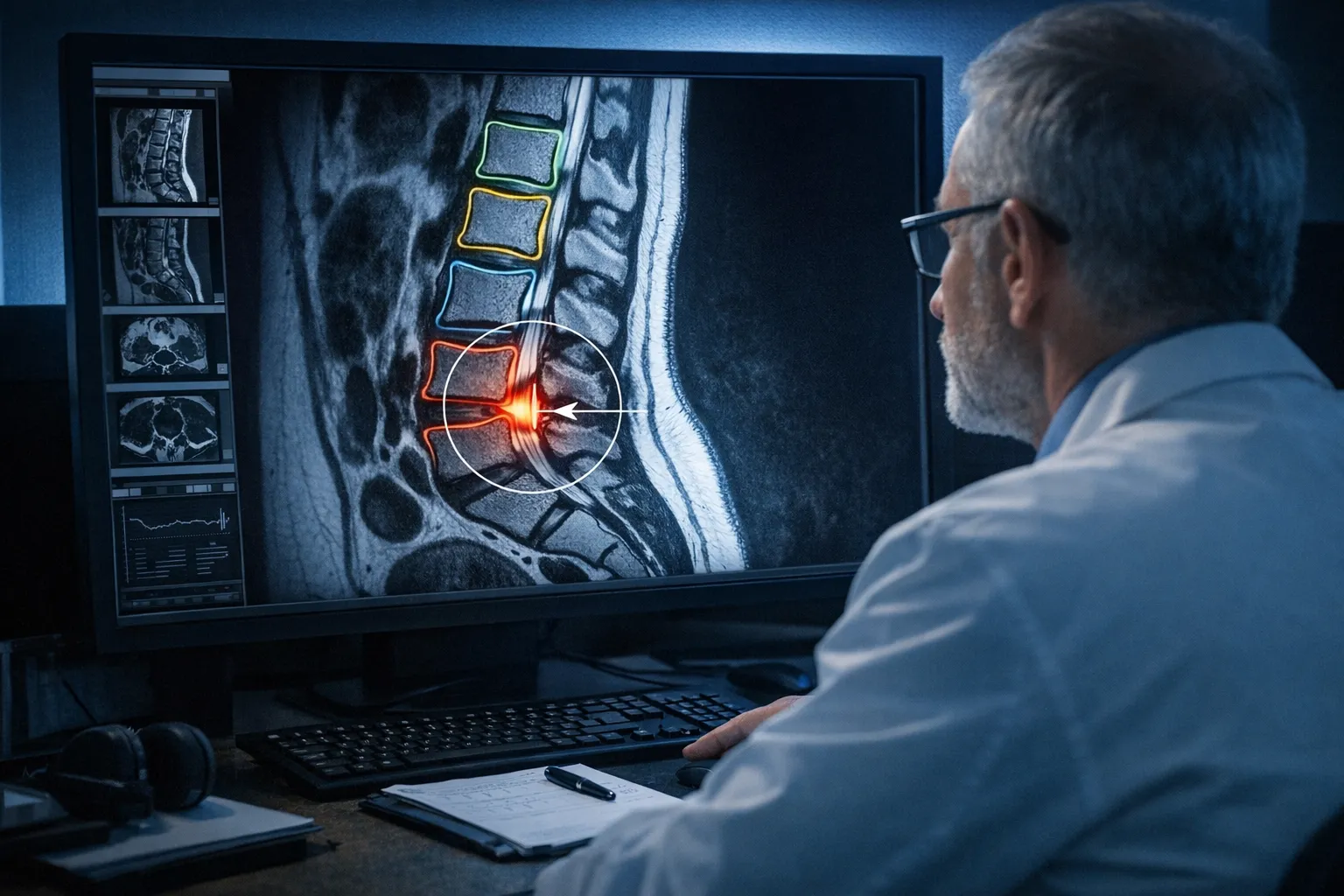
Most pain practices don't own imaging, but they read a lot of it. AI spinal imaging tools are increasingly relevant either through referral radiology partners or through in-clinic MRI review workflows for procedural planning.
For interventional pain, the operational value is faster procedural planning, more consistent identification of stenosis levels, and clearer documentation for medical necessity — all of which shorten the path from imaging to injection and reduce PA rework.
What to evaluate: FDA clearance status, integration with your referring radiology partners' PACS, and whether the tool outputs annotated reports you can attach to PA submissions.
6. AI Voice + SMS Front Desk — Greetmate
Category: Voice and SMS automation for scheduling, intake, and after-hours coverage
Every pain practice has the same phone problem, just at different scales. Chronic-pain patients drive relentless inbound call volume — refill requests, injection scheduling, pre-op questions, post-procedure check-ins, insurance verifications, no-show recovery. When the front desk gets buried, calls go to voicemail, and voicemail is where patients disappear. The MGMA has documented that reducing missed calls at Valley View was strongly correlated with a 17% increase in work RVUs — a rare, causally clean data point on what phone access actually drives in outpatient revenue.
Greetmate is AI voice and SMS infrastructure purpose-built for U.S. healthcare operations, delivered as a tech-enabled service — implemented, not just activated. For pain management practices, that translates into three concrete workflow layers:
Inbound routing and scheduling. Greetmate answers every incoming call, routes the calls your clinical leadership has flagged to a person immediately, books and reschedules injections within your practice-defined rules, and confirms insurance and referral status upfront.
After-hours and overflow. Instead of dumping evening and weekend chronic-pain callers into voicemail, calls are captured, routed, and either scheduled or queued with structured SMS follow-up.
Reactivation, reminders, and no-show recovery. SMS workflows for pre-procedure prep, PA-status updates, refill cadence, and lapsed-patient outreach. What each one runs against — the EHR where its API supports it, the practice's calendar, or a list the team maintains — depends on the systems you actually run, and is confirmed during scoping.
Greetmate is HIPAA-ready with a BAA available, integrates with 300+ apps including athenahealth, Epic, ModMed, Tebra, eClinicalWorks, DrChrono, NexHealth, Canvas, and HIPAA-aligned middleware like Keragon, and is designed to automate roughly 70–80% of routine patient communication tasks. Unlike DIY voice-bot platforms, Greetmate is deployed through a white-glove rollout, with workflow design, integration, and analytics tuned to the practice's actual call mix.
For multi-location pain groups and MSO-managed pain networks, the operational visibility layer matters as much as the automation — Greetmate delivers standardized call handling across sites plus leadership reporting on scheduling outcomes, PA-related call volume, and handoff logs.
What to evaluate: Real EHR/PM integration depth (not just Zapier), configurability for controlled-substance and PA-related call flows, HIPAA posture, and whether the vendor implements the workflow or hands you a builder and walks away.
How Greetmate Transforms Healthcare Phone Operations:
Inbound Call Automation
Handle patient calls around the clock — including after-hours and overflow — so your front desk can focus on in-office care.
Appointment & Follow-Up Workflows
Automate appointment scheduling, patient follow-ups, and reactivation outreach through workflow-driven voice communication.
EHR & System Integrations
Connect with your existing EHR, scheduling tools, and operational systems for seamless, end-to-end patient communication.
See Greetmate in Action. Healthcare voice AI infrastructure — live in hours.
How to Sequence AI Adoption in a Pain Management Practice
No pain practice should deploy all six categories at once. The right sequence depends on where your operation is bleeding hardest today.
If your biggest constraint is…
Start with…
Physician after-hours charting
AI scribe
Denials, PA delays, AR aging
Prior authorization or RCM AI
Missed calls, no-shows, front-desk turnover
Voice + SMS AI
Documentation quality driving denials
Scribe + specialty EHR alignment
Multi-location inconsistency
Voice AI + RCM AI in parallel
The practices getting real return in 2026 aren't the ones with the longest AI stack — they're the ones that identified their #1 operational bottleneck, deployed one purpose-built tool against it, measured the outcome, and only then added the next layer.
FAQ: AI Tools for Pain Management Practices
What is the highest-ROI AI tool for a pain management practice?
For most interventional pain practices, the highest-ROI AI investment is either prior authorization automation or voice/SMS front-desk automation, depending on where the bottleneck sits. PA automation directly protects procedural revenue and reduces physician burnout tied to the ~13 hours per week staff and physicians spend on authorizations. Voice AI directly protects new-patient acquisition and scheduling yield.
Are AI medical scribes safe for pain management documentation?
AI scribes have been evaluated in multiple peer-reviewed studies showing meaningful documentation time reductions with no negative impact on patient experience, but they require physician review of every note before signature. Medico-legal risk guidance from TMLT and similar carriers emphasizes physician accountability for the final record — the scribe drafts, the physician signs.
Do AI tools need to be HIPAA-compliant to be used in a pain practice?
Any AI vendor handling PHI must be able to sign a Business Associate Agreement (BAA) and meet HIPAA safeguards for PHI handling, encryption, and access controls. This applies to scribes, RCM tools, PA platforms, and voice AI. If a vendor cannot provide a BAA or clear documentation of HIPAA posture, the tool should not touch PHI.
Can AI replace the front desk in a pain management practice?
No. AI voice and SMS platforms like Greetmate are designed to absorb routine, repeatable phone and messaging workflows — scheduling, confirmations, reminders, after-hours coverage, refill routing — so the front desk can focus on in-person patients, complex calls, and clinical coordination. The framing is operational leverage, not headcount replacement.
What's the difference between an AI receptionist and healthcare voice infrastructure?
An "AI receptionist" typically implies a self-serve chatbot-style tool that answers calls. Healthcare voice infrastructure — the category Greetmate operates in — is a workflow-integrated layer that connects to the EHR, PM system, calendar, and SMS channels, is implemented through white-glove rollout, and is measured against operational KPIs like scheduling yield, missed-call rate, and after-hours capture, not just call-answer rate.
The Bottom Line
The best AI tools for pain management practices in 2026 aren't a stack you buy in one shot — they're a sequenced set of decisions against your actual operational bottlenecks. Scribe fixes the physician's evenings. Specialty EHR fixes the documentation-to-billing bridge. PA and RCM AI fix the revenue side. Imaging AI fixes procedural planning. Voice and SMS AI fix the front door.
Of those six, the front door is the one most often overlooked — and the one that most directly determines whether new patients ever become patients at all. If your missed-call rate, after-hours coverage, or scheduling yield is where your pain practice is leaking hardest, that's where AI should land first.
Greetmate is healthcare voice and SMS infrastructure built specifically for the operational realities of U.S. specialty and multi-location practices — including interventional pain. If you're mapping your 2026 AI roadmap, book a demo and we'll walk through the specific call-flow, PA-triage, and multi-location patterns that pain groups deploy first.
More Blog Articles
Find helpful articles in our blog that are all about business, customer service and AI technology.
Five dental call types walked turn by turn: the new-patient inquiry, the reschedule, the insurance question, the urgent same-day call, and the hygiene recall, each ending in a booking or a clean handoff to your staff.
The write-back actions verified today for athenahealth, eClinicalWorks, Open Dental and Dentrix, the CRM routes for calls that don't belong in a chart, and who actually builds the workflow.