
Medical office phone scripts: 8 templates you can automate
Eight complete scripts for the calls your front desk gets every day, from records requests to recall, plus how each one becomes an automated call flow.
| Greetmate

It's 9:07 AM on a Tuesday. One staff member is mid-registration with a patient at the window. The phone has rung four times in the last three minutes. Hold queue: two callers. Insurance verification from yesterday afternoon is still open on the screen. A patient at the door wants to reschedule. And someone just left a voicemail overnight that nobody has listened to yet.
This isn't a bad day. This is the job.
Front desk overload in healthcare has become so normalized that most practices have stopped questioning it — and started cycling through the same response: post the job, hire someone, train them for six weeks, watch them burn out or leave, repeat. According to MGMA's 2024 workforce survey, front desk and administrative staff experience 30–40% annual turnover — roughly double the national industry average. The average time to fill those positions has grown from 25–30 days in 2020 to 45–60 days in 2024.
The hiring response doesn't solve the problem because the problem isn't a headcount problem. It's a structural one. The front desk job description has quietly expanded far beyond what any human team can reliably handle at scale — and until practices separate the work that requires a person from the work that doesn't, no amount of hiring will fix it.
This post breaks down where front desk capacity actually goes, what overload is really costing your practice, and what an operational fix looks like.
Table of Contents
Think about what a front desk role actually covers in a busy medical practice today: answering inbound calls, triaging urgency, scheduling and rescheduling appointments, verifying insurance, collecting copays, managing patient check-in and check-out, handling after-hours overflow (or failing to), sending appointment reminders, following up on no-shows, responding to portal messages, fielding billing questions, routing referrals, and doing all of it with a patient standing at the window.
This is not a reception job. It's an operations role with clinical adjacency, patient-facing responsibility, and revenue implications — staffed and compensated like a reception job.
MGMA's staffing data consistently identifies front-office staff as one of the highest-attrition roles in medical practices, with practice leaders citing demanding workloads, complex task requirements, and limited advancement paths as the primary drivers. It isn't that practices are hiring the wrong people. It's that the role has been allowed to accumulate every task that didn't fit anywhere else — and the volume has long since exceeded what a human team can reliably absorb.
At three locations, this is manageable. At seven, it's chaos. At fifteen, it's a structural liability.
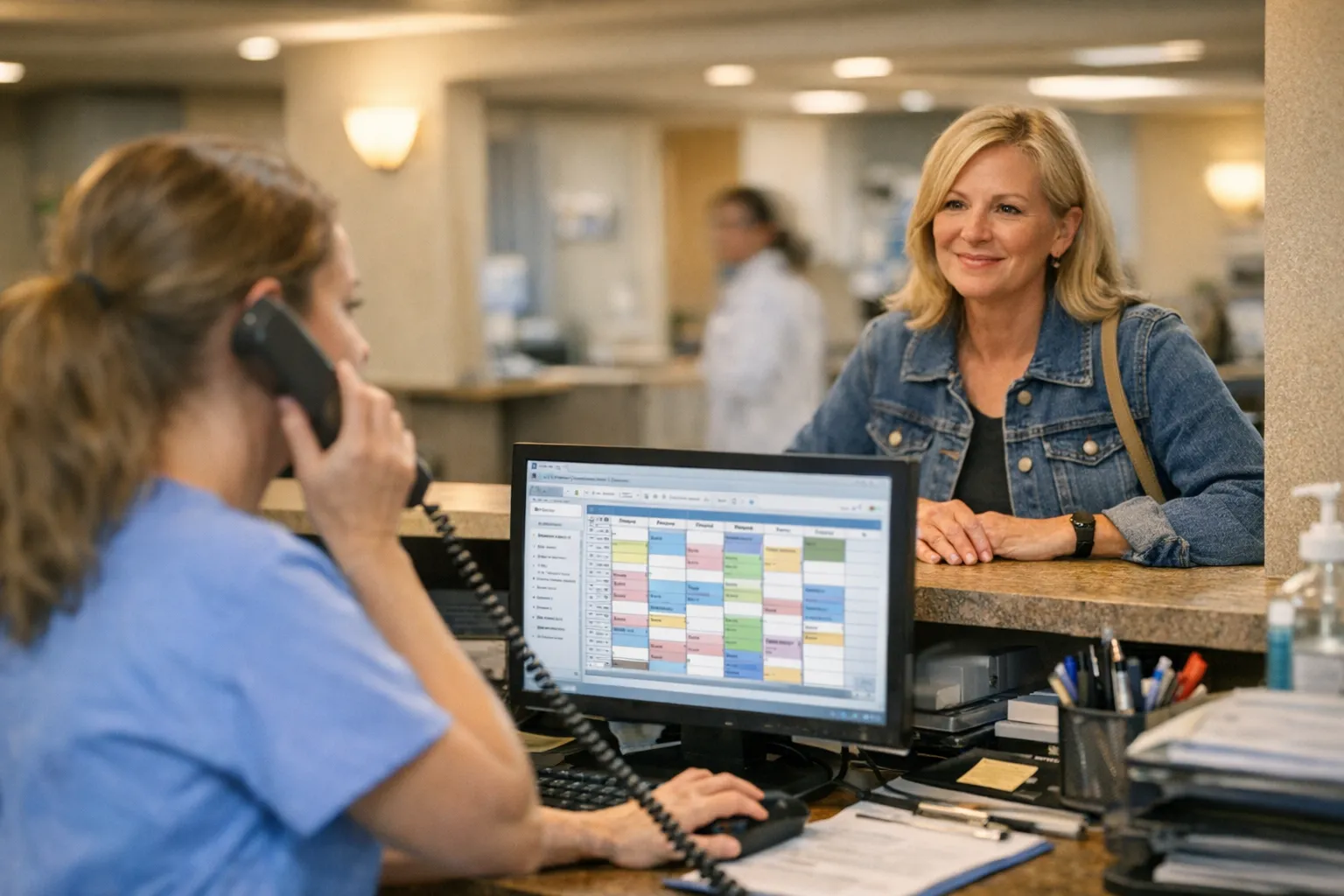
Front desk overload is caused by a specific problem: high-frequency, low-complexity tasks consuming the same human bandwidth as high-value, judgment-intensive ones. The fix isn't working faster — it's separating the two categories entirely.
Here's where the capacity goes.
Accenture research cited by Phreesia puts the average staff time per scheduling call at over 8 minutes. For a practice fielding 80–120 calls per day — not unusual for a 5–8 provider group — that's 10+ hours of staff time daily, just on inbound calls. That number doesn't include hold time, callbacks, or calls that go unanswered.
Inbound calls are also the highest-leakage point in the practice. Healthcare providers miss an average of 29% of inbound calls, and 85% of those patients never call back. Every unanswered call during a check-in rush, a lunch break, or a staffing gap isn't a delayed appointment — it's a lost one.
A significant portion of those calls don't require a human to resolve: appointment confirmations, directions, hours of operation, basic intake, scheduling for established patients, prescription refill routing. These are volume problems masquerading as staffing problems.
Manual reminder calls are one of the clearest examples of human time deployed against a task that doesn't warrant it. A staff member spending 20 minutes per day on reminder calls is consuming over 80 hours annually on a workflow that can be handled automatically — with better consistency and real-time confirmation tracking.
No-shows cost the U.S. healthcare system an estimated $150 billion annually. Automated, multi-touch reminder sequences — voice, SMS, or both — consistently outperform manual reminder calls on confirmation rates, and they don't compete with check-in traffic for staff attention.
After-hours is a structural gap that no staffing model fixes without significant cost. The options are: let calls go to voicemail (and lose a meaningful share of them), pay for a live answering service (expensive, inconsistent), or close the gap with an automated voice layer that handles what can be handled and escalates what can't.
A large-scale review of patient call data found that 11% of calls occur outside standard business hours — even in practices with predictable daytime schedules. For urgent care, behavioral health, or any specialty where urgency is real, that after-hours gap has direct patient and revenue consequences.
Pre-visit intake and insurance verification are time-intensive, error-prone when done manually under pressure, and almost entirely automatable. These workflows are pulling your front desk team backward — into tasks that should be completed before the patient walks in — rather than forward into the patient experience that's actually happening in front of them.
Where Front Desk Time Goes Daily (Est. Hours, 5–8 Provider Practice)
The turnover math is well-documented. Replacing one front desk employee costs $14,000–$26,000 when you account for recruiting, training, manager time, lost productivity during the 90-day ramp, and coverage costs. For a 15-location group with 45 front desk staff and 30% annual turnover, that's roughly $196,000–$364,000 in direct replacement costs per year — before counting what those positions produce while vacant or understaffed.
But turnover is only part of the cost picture.
Dialzara's analysis of healthcare-specific missed call costs puts the per-missed-call cost at $175–$200 in immediate appointment value. For a practice missing 20 calls per day, that's $3,500–$4,000 in daily revenue exposure — before accounting for lifetime patient value. For specialty practices, patient10x's analysis notes that missed calls can cost $300,000–$800,000 annually when lifetime value is factored in.
This is not a hypothetical. It's the direct output of a front desk team that is too busy answering the call at the window to answer the call on the phone.
As explored in Every Missed Call Is a Lost Patient, the revenue math on missed calls compounds fast — and most of it never appears on a P&L line because it's invisible: the patient who didn't get through, didn't call back, and quietly became someone else's patient.
The hidden revenue leak: At $175–$200 per missed call, a practice missing just 20 calls per day is exposed to $3,500–$4,000 in daily lost appointment revenue. Over a year, that's well into six figures — before accounting for lost lifetime patient value.
Single-location practices experience front desk overload as a daily operational problem. Multi-location groups experience it as a systemic one.
Each location carries its own staffing gap, its own training cycle, its own call handling inconsistencies. There's no standardization of how calls are answered, how overflow is handled, how after-hours routing works, or how reminders go out. The result: patients in different locations of the same practice have materially different experiences — and the operations team has no visibility into why.
For a 10-location orthopedic group, the missed call problem isn't happening at one front desk. It's happening at ten, simultaneously, with no consolidated reporting to show it.
The instinctive response to front desk overload is to post another job. It's understandable — the problem presents as a people shortage, so the solution looks like more people.
But over half of healthcare providers are struggling to fill administrative positions even when they're actively trying. The labor pool has tightened, wage expectations have risen (average front desk hourly wages increased 9.5% between 2022 and 2024 per BLS data), and the competition for entry-level administrative talent now includes retail and service sectors offering comparable pay with less stress.
Even when a hire is made, the capacity gain is temporary. New staff answer calls 20–30% slower during their initial 90 days, reducing revenue conversion precisely when the practice most needs it. The 90-day ramp is also when new hires are most likely to decide the role isn't for them.
More critically: adding headcount doesn't change which tasks are consuming your team. It just distributes the same overloaded job description across more people — until they burn out too.
46% of all health workers reported frequent burnout in 2022, up from 32% in 2018. The trajectory hasn't reversed. Practices that solve overload by hiring more people are not solving overload — they're deferring it.

The hiring cycle trap: Adding headcount doesn't change which tasks are consuming your team. It distributes the same overloaded job description across more people — until they burn out too. 46% of all health workers reported frequent burnout in 2022, up from 32% in 2018.
The practices that have stabilized their front desk operations — without perpetual hiring cycles — share a common approach: they've drawn a clear line between what requires a human and what doesn't, and they've put operational infrastructure in place to handle the latter.
That infrastructure looks like:
An automated voice layer that answers every call. Not a voicemail box. Not a basic IVR tree. A voice workflow that can handle scheduling for established patients, confirm appointments, capture intake information, route urgent calls to the right person, and manage after-hours coverage — with a warm handoff to staff when the situation requires human judgment.
Automated reminder and confirmation sequences. Multi-touch, configurable by appointment type, running without staff involvement. Confirmation data feeds back into the schedule so staff can see what's confirmed, what isn't, and where to focus follow-up attention.
Intake and insurance verification workflows that run before the patient arrives. Not at check-in, while someone is standing at the window. Before — so the front desk team is managing the visit, not catching up on the paperwork.
Consistent call handling across every location. The same routing logic, the same overflow rules, the same after-hours behavior — whether it's location one or location twelve.
Visibility into what's happening. Not just call handling — reporting on scheduling outcomes, overflow volume, after-hours traffic, and handoff logs, so operations leadership can see where the gaps are and make decisions based on data rather than intuition.
Key Takeaways:
This is the operational model that reduces front desk workload meaningfully — not by replacing the front desk team, but by removing the tasks that were never a good use of their time.
If you're evaluating what this kind of infrastructure looks like in practice, Greetmate's software page walks through the workflow builder, call routing, and reporting layer in detail.
Greetmate is designed specifically for this model: healthcare voice and SMS AI infrastructure, built for provider organizations managing real inbound call volume. The platform automates the routine communication layer — inbound calls, reminders, after-hours coverage, intake capture, follow-up — and integrates directly with the EHRs and practice management systems your team already uses, including athenahealth, Epic, ModMed, Tebra, eClinicalWorks, Dentrix, and Open Dental, among 300+ supported integrations.
Implementations are guided, not self-serve. Basic deployments can be live within hours. The result: front desk staff focused on the patient in front of them, not the phone ringing behind them.
For multi-location groups where the compounding problem is most acute, standardized AI phone operations across sites is where the operational leverage is highest — consistent call handling, consolidated reporting, and no-gap coverage regardless of which location a patient calls.
Reduce front-desk call volume and improve patient communication.
Go live in hours with done-for-you setup.
The primary driver is task accumulation: front desk roles have absorbed scheduling, insurance verification, reminder calls, after-hours coverage, intake capture, and billing questions — on top of patient-facing check-in and check-out. When inbound call volume is high and staffing is lean, these tasks compete directly for the same human bandwidth, creating chronic overload regardless of how capable the team is.
Direct replacement costs run $14,000–$26,000 per departure, accounting for recruiting, training, lost productivity during the 90-day ramp, and coverage. For a multi-location group replacing 10–15 staff annually, total direct costs can exceed $200,000 per year — before counting the revenue lost while positions are vacant or understaffed.
Yes — when implemented correctly. The key distinction is between tasks that require human judgment (complex scheduling, clinical triage, sensitive conversations) and those that don't (appointment confirmations, directions, intake capture, basic scheduling, after-hours routing). Automating the latter frees the front desk team to do the former better. Leading health systems have eliminated over 60% of call volume through intelligent automation without degrading patient satisfaction — because patients primarily want fast, accurate responses, not a specific channel to get them.
A phone system upgrade changes how calls are routed. Operational infrastructure changes what happens to those calls — and what gets reported back to leadership. The distinction is workflow depth: does the system handle scheduling, capture intake, integrate with the EHR, manage after-hours, and produce reporting on outcomes? If the answer is no, it's a routing improvement, not an operational fix. For practices with meaningful call volume, the difference in outcome is significant.
Directly and measurably. Overloaded front desks miss calls — and 85% of patients who don't get through never call back. At $175–$200 per missed call in immediate appointment value, a practice missing 20 calls per day is carrying $3,500–$4,000 in daily revenue exposure. Over a year, that's well into six figures — before accounting for the lifetime value of patients who quietly switched providers. See How to Capture Every Patient Inquiry Without Adding Staff for a fuller breakdown.
Front desk overload isn't a people problem. It's a design problem — a job description that has accumulated every task that didn't fit anywhere else, deployed against a labor market that makes those roles harder to fill and retain every year.
The practices that break the cycle aren't the ones that hire faster. They're the ones that draw a clear line between what requires a human and what doesn't — and put the right operational infrastructure in place to handle the latter at scale, consistently, across every location.
Your front desk team is capable of doing the high-value work: managing complex patient interactions, handling clinical adjacency with care, building the relationships that keep patients in your practice. They just can't do that and answer 100 calls a day and send manual reminders and cover after-hours and verify insurance at check-in. Nobody can.
The question isn't whether to automate the routine layer. It's how long you can afford not to.
See how Greetmate works in practice. Book a demo and we'll walk through what a guided deployment looks like for your call volume, your EHR, and your locations.
Find helpful articles in our blog that are all about business, customer service and AI technology.
Eight complete scripts for the calls your front desk gets every day, from records requests to recall, plus how each one becomes an automated call flow.
Outsourcing, another hire, or automation with human overflow. Which one fits depends on your call pattern, not the vendor's pitch.
