Automated patient outreach from a spreadsheet: 7 steps
Every practice has an overdue-patient list nobody has the hours to call. Here is the row-by-row workflow that works it down, starting from the export you already have.
| Greetmate

Most practices shop for coverage by comparing per-minute rates. That number is the easiest part of a medical answering service cost to compare, and it predicts your total spend worse than almost anything else on the quote. The invoice covers the minutes the service spent on the phone. It does not cover the work those messages create the next morning.
Cub Larkin describes what that looked like for his team: the service left them with "unorganized voicemail backlogs." The calls were answered, but nothing was finished. Somebody at the front desk still had to open every message, find the chart, call the patient back, and hope the patient picked up.
So below are the four billing models the industry actually uses, with published market ranges, followed by the charges that rarely show up on a first quote, starting with the billing-cycle detail that adds a thirteenth invoice to your year. The last part is a formula for cost per resolved call that you can run on your own invoice and message log this week, plus an honest read on where a live answering service is still the right answer.
Key Takeaways:
Table of Contents
In 2026, published market pricing for medical answering services runs roughly $25 to $100 per month for basic message-taking and $1,000 to $3,000+ per month for 24/7 coverage of a multi-provider practice. Usage is billed per minute at approximately $1.75 to $2.25, or per call at approximately $0.96 to $1.84.
Those are vendor-published market ranges, not a quote from anyone. They come from cost guides written by companies that sell the service, so treat them as the shape of the market rather than as a benchmark you should expect to hit.
| Billing model | Published market range | What it means in practice |
|---|---|---|
| Per minute | $1.75–$2.25/min for 2026; a wider survey puts the band at $0.93–$3.09/min | You pay for talk time, hold time and often patch/transfer time. Long calls are expensive; the rounding rule decides how expensive. |
| Per call | $0.96–$1.84/call; one buying guide models 500 calls at roughly $700–$1,470/month | Predictable per unit, but the contract's definition of a billable call does the heavy lifting: hang-ups, wrong numbers and repeat callers may all count. |
| Flat monthly / tiered plan | $25–$100/month basic, up to $1,000–$3,000+ for 24/7 multi-provider coverage | Includes an allowance. The allowance, not the base fee, is the number that matters. |
| Per user / per provider | Quoted per seat or per provider; ranges vary too widely to publish a credible market figure | Scales with headcount rather than with call volume, which decouples price from the thing driving cost. |
Most quotes are a hybrid: a monthly base with an included allowance, then a usage rate above it. Two vendors can quote the same base fee and produce invoices 40% apart.
Comparing the rates is the obvious first move. Run the arithmetic, though, and the rates barely decide it.
Take a per-call rate at the top of the published band, $1.84, against a per-minute rate at the bottom of the 2026 band, $1.75. The two break even at just over one minute of talk time, and almost no medical call is under a minute. Hyro's study of roughly 300,000 patient calls put average handle time in healthcare call centers at 6.6 minutes. That figure is from 2023 and covers large in-house centers, so use it as a structural reference rather than a 2026 number, but the direction is clear enough.
On rates alone, then, per-call wins nearly every time, which tells you the rate is not where the money is. The money is in the definition of the billable unit.
Here is an illustrative comparison. Assumptions: 400 after-hours calls per month, an assumed 2.5-minute average handle time, priced at the published market ranges above. This is an example, not a quote.
Illustrative monthly cost of 400 after-hours calls (assumed 2.5-min average)
The gap looks decisive until you ask the questions that close it:
Ask for those three answers in writing before you compare a single rate.
The most useful thing to check on any coverage contract is also the least discussed. Many answering services bill on 28-day cycles rather than calendar months. Twenty-eight days into 365 gives you 13 billing periods a year, not 12.
Applied to a $1,200 monthly quote, as an illustration: 13 cycles is $15,600 a year against the $14,400 you budgeted, so your effective monthly cost is $1,300. Before you compare two quotes, multiply any 28-day quote by 13/12.
Normalize before you compare. A 28-day quote of $1,200 and a calendar-month quote of $1,290 are effectively the same price. One of them will look 7% cheaper on your spreadsheet.
The rest of the fee schedule, as published by services themselves:
| Fee | Published market range |
|---|---|
| Setup / onboarding | $50–$500; another guide lists $100–$500 |
| Holiday premium | 1.5–2× standard rates |
| After-hours premium | +25–50% |
| Overage above allowance | $1.50–$3.50/min |
| Per-message delivery | $0.25–$0.75 per message |
| Scheduling / EHR integration | $200–$800 setup plus a monthly fee |
| Early termination | $200–$1,000 |
| Number porting | $50–$200 |
The after-hours premium deserves a second look, because after-hours is usually the entire reason you are buying. If 100% of your covered volume carries a 25–50% premium, that premium is not an edge case. It is your rate.
No quote prices this part. A message is a record of a call, not a completed one. The service was paid to handle the interaction, and somebody on your payroll still has to finish it.
Healthcare call centers average 52% first-call resolution. Hyro's data found only 1% of healthcare call centers reach 80–100% FCR against a 70–79% standard, with transfer rates as high as 19%. Those figures describe staffed clinical call centers with chart access. A message-taking service resolves less than that by design, because message-taking is the product.
None of this is a comment on your front desk. The people answering your phones are absorbing the overflow that the coverage contract was supposed to remove. The phone is the bottleneck, not the team, and a service that logs calls rather than closing them hands that bottleneck straight back at 8:00 a.m.
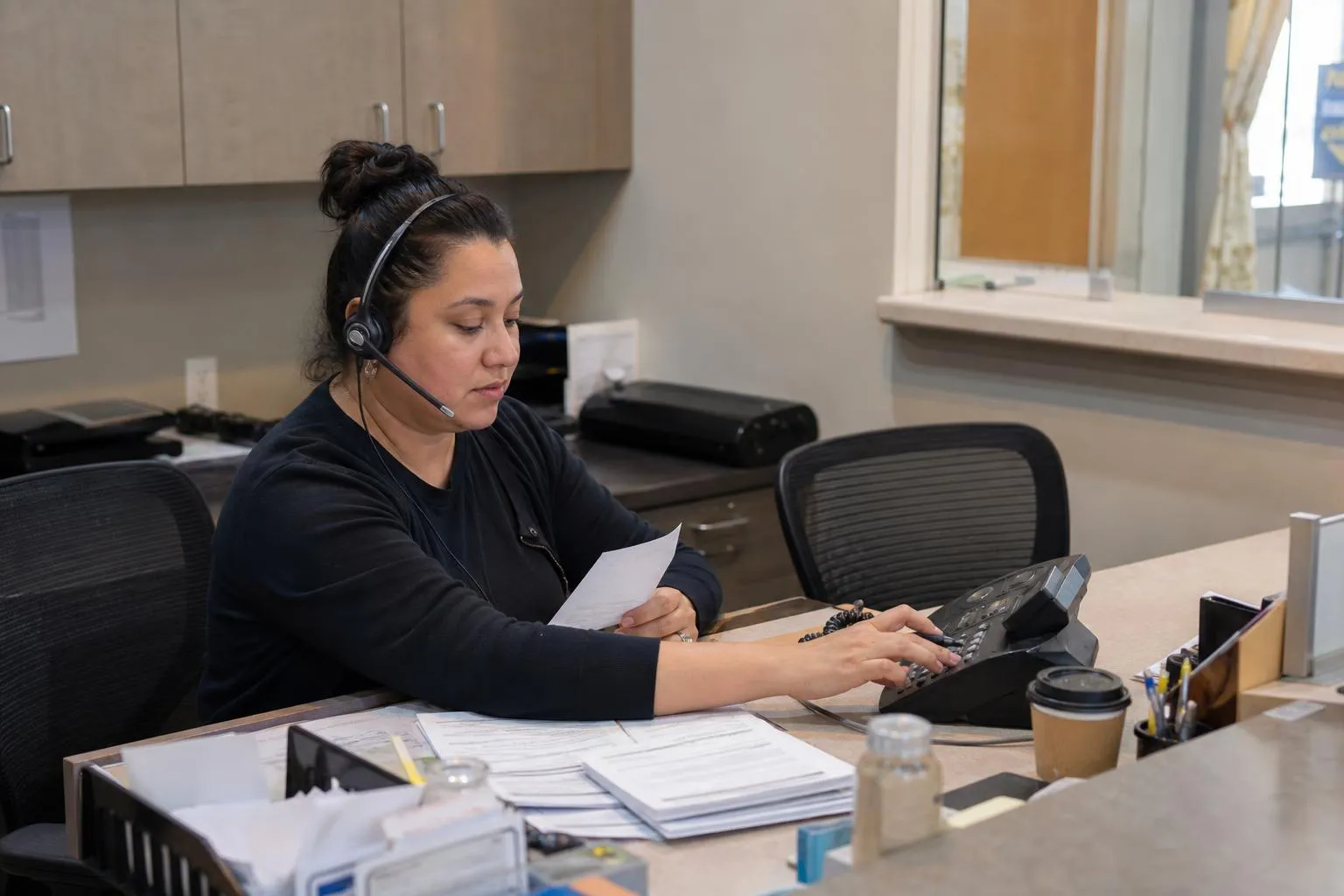
There is a second cost that gets far less attention. Integration setup at $200–$800 plus a monthly fee is documented on plenty of price lists. What nobody prices is the labor when there is no write-back at all: the appointment gets typed into the scheduler by hand, the caller's details get re-entered into the chart, the reason for the call gets summarized into a note. Every one of those keystrokes is a second data entry of information the caller already gave once.
That leakage compounds. We have written before about the revenue math behind missed and unreturned calls, and the pattern is the same whether the call was never answered or answered and never closed.
Every pricing guide on the internet divides total spend by calls handled. That counts a message-taken call as delivered. Change the denominator and the picture changes:
Cost per resolved call = (vendor invoice + internal callback labor) ÷ calls that required no further staff action
Every figure below is an assumption stated for the purpose of the example, not a benchmark and not a quote.
Total monthly cost: $2,572. Calls needing no further staff action: 160.
| Metric | Result |
|---|---|
| Cost per call (the number on the quote) | $4.75 |
| Cost per resolved call (the number that matters) | $16.08 |
The gap between those two figures is the part of the spend that never appears in a vendor comparison.
Worth knowing before you assume outsourcing is automatically the cheaper unit: a peer-reviewed comparison across roughly 300,000 calls at a large urology group found outsourced calls cost $3.59 each against $4.02 for the internal team, a difference that was not statistically significant (P=0.152). Outsourcing did not win on price. If it is going to win at all, it has to win on resolution.
We are not competing with answering services on price, so this section is easy to write honestly. There are three situations where a live service is the correct answer.
Nurse triage with clinical protocols. If you need licensed clinical judgment applied to symptom calls overnight, buy licensed clinical judgment. Nothing in this article argues otherwise.
Genuinely low overnight volume. Basic message-taking at $25–$100/month is inexpensive for a practice taking a handful of overnight calls a week. Hyro's data found only 19% of healthcare call centers run 24/7, with about 11% of calls falling outside regular hours. If your after-hours volume sits at the low end of that, a minimum-fee service will beat any infrastructure investment on cost, and the callback labor is small enough not to matter.
A deliberate policy of a human voice overnight. Some organizations decide that a person answers at 2:00 a.m., full stop. That is a legitimate operating decision, and it should be priced as one.
Where the math turns is when your overnight and overflow volume is high enough that the callback queue becomes a standing item on somebody's morning. If you are weighing structures rather than vendors, our breakdown of four after-hours coverage models for medical offices walks through the trade-offs side by side.
If you want a second pair of eyes on your own invoice and message log, we will run the cost-per-resolved-call math with you on a discovery call. No obligation to buy anything to have that conversation.
Reduce front-desk call volume and improve patient communication.
Go live in hours with done-for-you setup.
Run the formula and one line does most of the damage: callback labor. Reduce the number of calls that come back as work and the whole equation moves, because you are removing cost from both the numerator and the denominator at the same time.
The front desk feels that first. Nobody opens the morning with a queue of things that other people already talked to patients about. There are fewer interruptions during clinic hours, less re-entry, and less phone tag with people who called twelve hours ago and have since gone to work.
The practice outcome follows from that. An after-hours request that gets booked at 9:15 p.m. is an appointment on tomorrow's schedule. The same request captured as a message is a callback with a chance of connecting and a chance of the patient having booked elsewhere by lunchtime, a pattern we have covered in the case for responding first.
The patient never sees any of this. They call at 9:00 p.m., get an answer, and get on the schedule.
Two Greetmate deployments show the shape of it. Both are behavioral health practices, so treat these as deployment results rather than a general benchmark. Across 836 calls at Inclusive Therapy Group between September 2024 and January 2026, 68% arrived after hours, 33% were resolved at first contact without staff involvement, 217 callbacks were eliminated and 69.5 staff hours were recovered. At On Your Mind Counseling, 520 calls ran 73% after-hours, 41% were resolved at first contact, 357 voicemails were avoided and 60.7 hours of caller hold time were removed.
Cub Larkin is direct about the intent: "our intent was not to replace staff." The point of removing 217 callbacks is not a smaller team. It is a team that spends its day on the patients in front of it.
The mechanism underneath is workflow rather than conversation. Structured call flows with defined escalation paths, integration with dozens of EHRs so bookings and call outcomes land in the systems your staff already work in, and reporting that tells leadership what callers actually wanted rather than how many minutes were billed. For groups running several sites, that same structure is what makes the patient experience consistent across locations instead of dependent on which office picked up.
You came here on a pricing question, so here is how ours works.
Greetmate is priced as healthcare infrastructure rather than as a per-minute utility. Every engagement is scoped to your call volume and to the complexity of the workflows you want built, which is why the figure comes out of a scoping conversation rather than off a rate card. What you are buying is not talk time. It is a set of workflows designed, built and run inside your operation.
That places Greetmate above the commodity phone bots, and the difference is what happens before go-live and what keeps happening after.
The self-serve software mode exists, but only as an optional handoff after the managed phase. It is not how anyone starts.
Note on figures: All market pricing in this article is drawn from publicly published vendor guides and is presented as a market range, not as a quote from Greetmate or from any named service. The worked examples are illustrative, with every assumption stated. Confirm your own compliance obligations with qualified counsel.

Published market ranges run roughly $25–$100 per month for basic message-taking and $1,000–$3,000+ per month for 24/7 multi-provider coverage, with usage billed at about $1.75–$2.25 per minute or $0.96–$1.84 per call. Your real figure depends on premiums, overage and how a billable unit is defined.
An answering service typically covers overflow and after-hours calls and delivers messages back to your team. A medical call center handles a broader scope during business hours, including scheduling, triage routing, referrals and patient questions, usually with system access. The practical difference is whether the call gets closed or forwarded.
Usually, yes, particularly the setup fee, the included allowance and the contract term. The line worth negotiating hardest is the overage rate, since that is where a quote turns into an invoice. Ask for the rounding increment in writing before discussing price.
A service handling protected health information on behalf of your practice generally acts as a business associate, which means a signed business associate agreement is required. Ask for the BAA in writing, along with how call recordings and message data are stored and retained. Confirm your specific obligations with counsel.
Some can, usually as a paid integration. Market listings show scheduling or EHR integration setup at roughly $200–$800 plus a monthly fee, and many services only take a message. Ask specifically which fields they can write and whether your staff still has to re-enter anything.
The invoice is the smaller half of what after-hours coverage costs you. The bigger half sits in the callback queue at 8:00 a.m., staffed by people who are already stretched, doing work that a second conversation was supposed to have finished.
Run one number before you sign anything: total spend plus callback labor, divided by the calls that needed no further staff action. That is your cost per resolved call, and it is the only figure that compares two coverage models honestly.
Greetmate is healthcare voice and SMS AI infrastructure, delivered with the workflow design, integration and implementation work done before go-live rather than handed to your team afterward. If you want to see what your own numbers look like under that framework, bring your last invoice and your message log.
Handle patient calls around the clock — including after-hours and overflow — so your front desk can focus on in-office care.
Automate appointment scheduling, patient follow-ups, and reactivation outreach through workflow-driven voice communication.
Connect with your existing EHR, scheduling tools, and operational systems for seamless, end-to-end patient communication.
See Greetmate in Action.
Healthcare voice AI infrastructure — live in hours.
Find helpful articles in our blog that are all about business, customer service and AI technology.
Every practice has an overdue-patient list nobody has the hours to call. Here is the row-by-row workflow that works it down, starting from the export you already have.
Post-call summaries arrive after the caller is gone. Six webhook events, with JSON payloads, that start the workflow while the conversation is still live, plus the idempotency and PHI-minimization rules that keep them reliable.