Get AI call notes into your EHR without writing code
The write-back actions verified today for athenahealth, eClinicalWorks, Open Dental and Dentrix, the CRM routes for calls that don't belong in a chart, and who actually builds the workflow.
| Greetmate
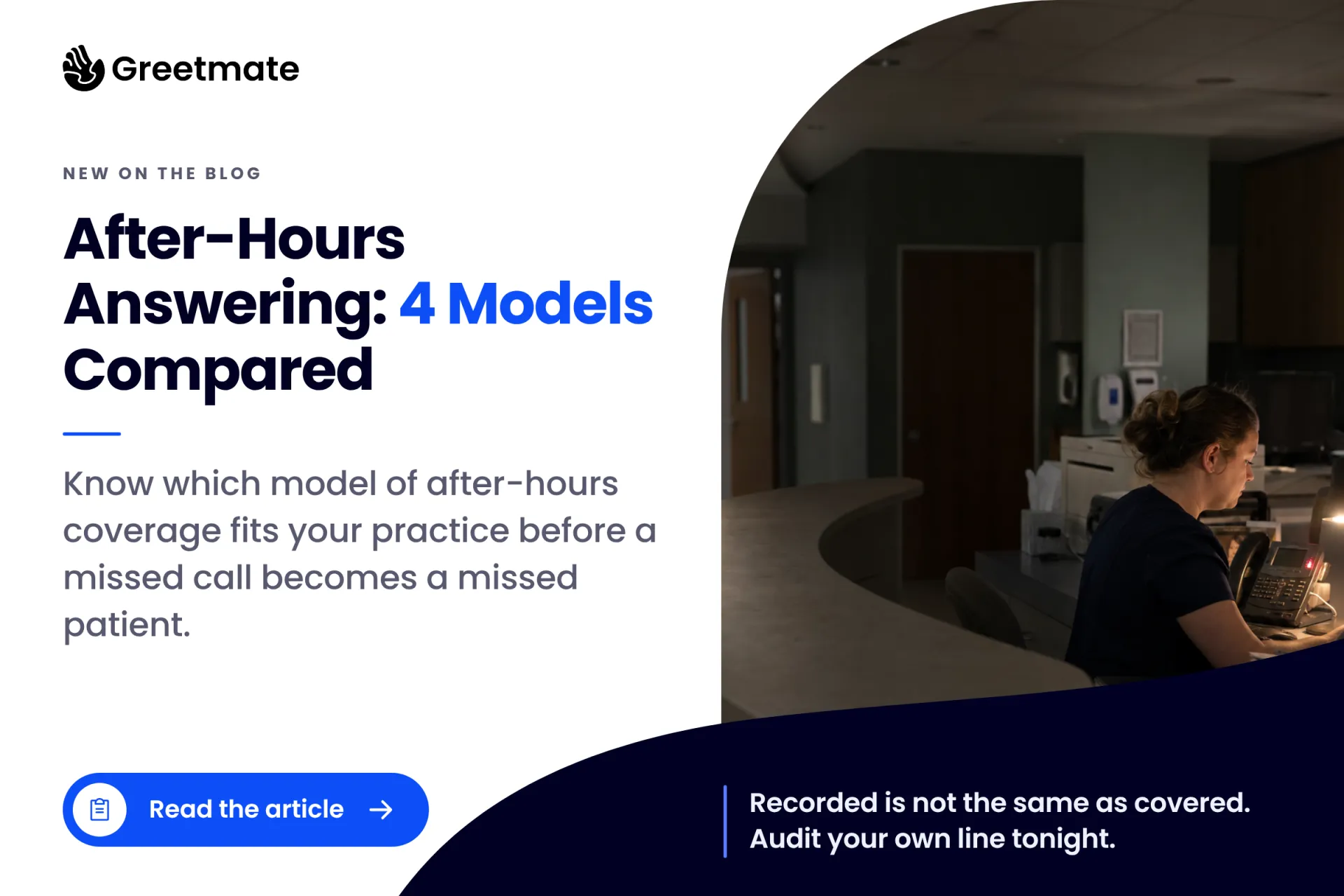
At 6:47pm on a Tuesday, a patient at a six-provider orthopedic group calls the main line to ask about her follow-up appointment. The front desk left at 6:00. What happens in the next ninety seconds comes down to a coverage model somebody chose, often years ago and often by default. Administrators who go looking at after hours answering services for medical offices usually end up comparing vendors, but the outcome of that 6:47pm call is set by the design behind the phone: who gets contacted, who doesn't, and what reaches the schedule by 8am.
Message-taking is the easy part. Escalation authority and the morning handoff are the hard parts, and a practice that says "we have after-hours covered" often only has after-hours recorded.
What follows traces that call through the four coverage models practices actually run, names where each one fails, sets out what a designed after-hours flow specifies in writing, and closes with a seven-step audit you can run on your own line tonight.
Key Takeaways:
Table of Contents
Patients don't stop having questions at closing time. They just stop having anyone to ask, and the response infrastructure has historically been thin.
In a 2012 study published in the Journal of General Internal Medicine, only 29% of U.S. physicians reported that their practice had arrangements for after-hours care beyond an automated phone referral, and only 30% of patients described getting care on nights and weekends as very or somewhat easy.
So the 6:47pm call has three realistic destinations in most 2–20 provider groups: a voicemail box, a contracted operator reading someone else's script, or a physician's personal cell phone. Each one produces a different overnight record, a different escalation decision, and a different Wednesday morning.
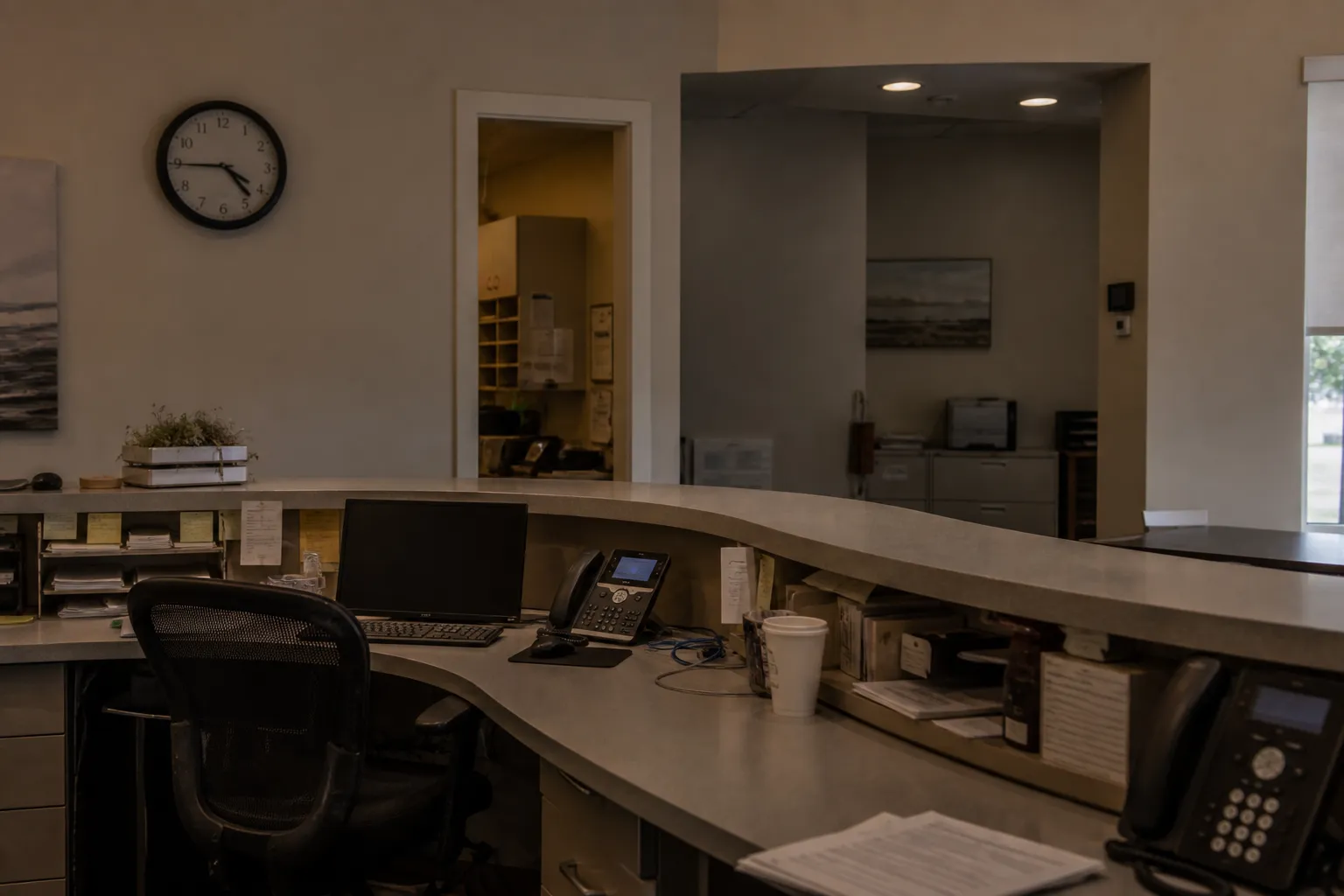
An after-hours medical answering service is a coverage arrangement that answers patient calls when the practice is closed, generally 5 p.m. to 8 a.m. plus weekends and holidays. It captures the reason for calling, applies the practice's own rules about which calls need immediate attention, escalates those to the on-call provider, and delivers everything else to staff the following morning.
That definition is where most vendor pages stop, and it's the part of the job that has been commoditized. Answering a ringing phone at 9pm is table stakes. Three things determine whether the arrangement actually works:
Miss those and you have a transcript service. Get them right and after-hours turns into a scheduling channel instead of a liability.
Before evaluating vendors, name your current model honestly. All four below are defensible choices for some practices. The difference isn't who answers. It's who authored the rules and where the call lands afterward.
| Model | Who answers | Who decides priority | What reaches the schedule by 8am | Where it breaks |
|---|---|---|---|---|
| Voicemail | Nobody | The patient, alone | Only what the patient chose to record | No priority signal, no callback commitment, no log of who called and didn't leave a message |
| Per-minute answering service | Live operator | Operator, following rules someone else wrote | Free-text messages, delivered in a batch | Protocol depth, documentation quality, and escalation left to interpretation under time pressure |
| On-call provider's cell | The provider | The provider | Whatever the provider remembers to relay in the morning | On-call load, rotation fatigue, and zero operational record |
| Automated / managed coverage | A structured call flow, with defined escalation to on-call | Rules authored in advance by the practice | Structured records, appointment requests, a priority-tagged queue | Only as strong as the flow design, testing, and refinement behind it |
Voicemail is not a coverage model. It's a recording device with a coverage model's job title. The patient decides whether their situation warrants pressing 0, hanging up, or waiting until morning. That is a decision the practice should be making with a written rule, not one the caller should be left to make alone at 9pm.
The asymmetry that makes voicemail expensive: you learn about the calls that left messages. You learn nothing about the ones that didn't. In our experience, roughly 85% of callers who reach voicemail simply don't call back. They call the next practice on the list.
The revenue side of this is well covered in Every Missed Call Is a Lost Patient. The operational point here is narrower: with voicemail there is no priority tag, no callback promise the patient heard out loud, and no record that leadership can audit. None of that is a reflection on the front desk. The constraint is the hour, not the team.
A traditional after hours medical answering service is a genuine step up from voicemail. A human answers at 2am. Calls get logged. Priority items get paged out. For practices coming from a voicemail box, contracting a medical office answering service usually improves patient experience immediately, and that's worth acknowledging plainly.
The structural issue is different: an answering service executes a protocol, it does not author one. If the protocol your service is working from is three years old, ten lines long, and silent on half the call types your specialty actually receives, the operator will make a reasonable-sounding decision that nobody in your practice designed.
Research on after-hours telephone services has documented the weak points precisely. A 2024 review in JMIR Human Factors identified absence of specific formal training, low-quality and inflexible protocols, problematic documentation, and call-duration limits or per-call compensation that incentivize concluding sessions promptly among the recurring failure patterns. Separate work on out-of-hours telephone services has found measurable rates of documentation and handling errors under those same conditions.
That point about compensation structure matters commercially, because it explains why billing mechanics are a design input and not just a line item. Most services bill per minute or per call, with a monthly minimum, plus surcharges for overnight, weekend, and holiday coverage and sometimes for warm transfers. Any pricing model that makes a longer conversation more expensive shapes how long conversations last. When administrators ask what a medical answering service costs, the more useful question is what does this pricing model reward?
This is the model the search results almost never discuss, and it's everywhere in 2–20 provider groups: after 5pm, the line forwards to whoever holds the on-call phone.
It has one real advantage. A clinician makes the clinical decisions, and the resolution rate reflects that. In a randomized trial of after-hours remote call handling, 15.4% of calls (1,109/7,184) were resolved in the nurse-led arm versus 49.7% (3,629/7,308) in the physician-led arm.
After-hours calls resolved without further escalation, by who took the call
The cost is that every call becomes a physician-level decision. Refill requests, portal password confusion, a scheduling change, and a call that genuinely does need a provider all arrive through the same channel with the same ringtone. Structured routing is what keeps the wrong calls from reaching the wrong person: one UK program built on training, protocols and documentation reduced the need for GP contact by more than 50%.
The second cost is invisibility. There is no log, no priority tag, and no shared record of what was promised. Whatever the provider agreed to at 11:40pm exists only in their memory until they mention it Wednesday, if they mention it at all. The missing piece is the routing layer that on call after hours answering services are supposed to provide, which decides before the phone buzzes whether this particular call belongs to a provider at all.
Automated medical answering services replace the free-text message with a structured call flow. Done well, that means deterministic paths rather than a general-purpose bot improvising: each call type has a defined route, whether that's schedule, capture and queue, escalate to on-call, or direct the caller to the pathway the practice has specified. Intake is structured instead of a paragraph of notes. Records write back into the schedule and the practice's systems overnight, with the write-back configured and tested against the practice's own setup before go-live, so a Tuesday 9pm appointment request becomes a Wednesday 8am confirmed slot rather than a callback task. The caller gets an SMS confirming what happens next and when.
One distinction inside this category matters more than the marketing suggests. Some tools hand you a login and a blank workflow builder and call that a solution; the practice then owns the design, testing, edge cases, and rollout. Others deliver the flow as an implemented outcome (routing rules, escalation timers, fallbacks, QA) and refine it in the first weeks of live traffic. Those are very different purchases with very similar marketing.
For the mechanics of capturing volume without adding headcount, see How to Capture Every Patient Inquiry Without Adding Staff.
Here's the test for whether your coverage is designed or inherited: can someone print it? A real after-hours flow is a document, and it specifies five things.
Quick diagnostic: ask three people at your practice — the administrator, a front desk lead, and a provider on the rotation — what happens to a 9pm call about a medication refill. If you get three different answers, you don't have a protocol. You have three protocols.
If you want to see your own path mapped out, book a discovery call and we'll walk your current after-hours flow end to end before anything gets built. Also useful here: Your Front Desk Can't Do Everything.
Reduce front-desk call volume and improve patient communication.
Go live in hours with done-for-you setup.
Most after-hours revenue is won or lost between 8:00 and 9:30am, and almost nothing in the answering-service market is built for that ninety minutes. Even AI vendors describe the symptom accurately: staff arrive to a stack of messages with time-sensitive items mixed into routine ones, half of them missing details needed to act. Then they sell around it.
A clean overnight queue has five properties:
That last one is where most setups go silent. Practices routinely cannot answer "how many of last night's calls did we actually call back?" Speed of response decides who the patient books with, as covered in The ROI of Faster Patient Response Times. When the overnight queue arrives clean, the front desk starts the day working the schedule instead of reconstructing the night. When it arrives raw, the morning gets consumed by sorting that should already have happened. That's the same structural problem described in Front Desk Overload: The Real Constraint on Practice Growth.
Every result on page one for medical answering services ends in "get a quote." Run this instead. It takes about twenty minutes tonight and one hour tomorrow, and it tells you more than any sales call will.
After-hours is often a practice's least-instrumented and most consequential window. Six reportables make it visible:
A practice that can't answer these questions is running its most expensive hours blind. We treat reporting as a pillar rather than a dashboard, because handling the call is only half the job. Leadership also needs to see patterns, bottlenecks, and where staff action is required.
Everything above is a design problem, which is why buying a line rarely fixes it. Greetmate is healthcare voice and SMS infrastructure delivered as a managed engagement: we design the routing rules, escalation paths, timers, and fallbacks with your team, test them against your real call types, and refine them during the first weeks of live traffic. We implement the flow rather than just switching it on.
In practice, overnight calls follow deterministic paths instead of improvisation. Routine items get handled and written back into the schedule. Calls your protocol flags for a person escalate on a defined route to the right on-call contact, with context attached. Staff arrive to a priority-tagged queue instead of a pile. Across our deployments, roughly 70–80% of routine patient communication tasks can be automated this way, with front-desk workload reductions in the range of 35% or more. Nobody is replacing the front desk. The team just gets a start to the day it can actually work.
The flow reaches into the systems the practice already uses. Greetmate integrates with dozens of EHRs plus calendars, forms, inboxes, and scheduling systems, and workflows are built in a no-code builder so call paths can be adjusted as your protocols change. For groups running several sites, one flow can standardize how after-hours is handled everywhere, which addresses the multi-location consistency problem most administrators inherit rather than choose. Patient information is handled on a HIPAA-ready foundation with a BAA available.
On fit: this is a managed engagement with healthcare-infrastructure pricing, starting at $999–$2,500 per month depending on scope. That range is usually the starting point for a small deployment, and larger or multi-site engagements can run above it. It suits practices with real inbound volume, roughly 30+ calls a day, 2–20 providers or multi-site groups, and it is not a self-serve trial. Basic deployments frequently go live within hours. The design work around them is what takes the first weeks.
Note: This article addresses operational and communication workflow design only. It is not clinical guidance or legal advice. Any clinical criteria and escalation thresholds must be authored and approved by qualified clinicians at your organization; the routing simply executes what they decide.
It's a coverage arrangement that answers patient calls when the practice is closed, typically 5 p.m. to 8 a.m. plus weekends and holidays. It captures the reason for the call, applies the practice's routing rules, escalates the calls your protocol flags to the on-call provider, and delivers everything else to staff the next business morning.
Voicemail records; coverage decides. With voicemail, the patient sorts their own call and the practice only learns about calls that left messages. Real after-hours coverage applies defined rules to each call, escalates on a documented path, gives the caller a callback commitment, and produces a record leadership can audit.
Traditional services usually bill per minute or per call against a monthly minimum, often with surcharges for overnight, weekend, and holiday hours and for warm transfers. Managed and automated models typically price as a flat monthly engagement. A more useful question than the rate is what the pricing model rewards, since models that make longer calls costlier also shape how long calls run.
Practices with 2 to 20 providers taking 30 or more calls a day, plus multi-site groups running that pattern across locations. Below that volume, an on-call phone usually holds up. Above it, the overnight queue and the escalation rota start needing a written design.
Operationally, no. Routing everything to a provider is what creates rotation fatigue. But the filter has to be a written rule authored by your clinical leadership rather than an improvised judgment by whoever picked up, so the same call type gets the same handling every night.
It can recognise the conditions your clinical leadership has defined and escalate them on a predetermined route, whether that's the on-call provider, a nurse line, or the pathway named in the practice's protocol, with a timer and a fallback if the first contact doesn't respond. It routes and documents. Every clinical decision stays with the clinician.
The practices that handle after-hours well aren't the ones with the most expensive line. They're the ones where somebody sat down and decided, in advance, which calls reach a provider, what a caller is promised out loud, what gets written back to the schedule overnight, and what the queue looks like at 8am. Everything else, including vendor category, per-minute rate, and live operator versus structured flow, is downstream of that document.
The bottleneck is the phone after 5pm, not your front desk. Give the team a clean, priority-tagged queue at 8am and they'll convert overnight demand instead of reconstructing it.
If you want to see where your current flow actually breaks, book a discovery call. We'll map the 6:47pm path end to end (routing rules, escalation, morning handoff) before anyone talks about building anything.
Handle patient calls around the clock — including after-hours and overflow — so your front desk can focus on in-office care.
Automate appointment scheduling, patient follow-ups, and reactivation outreach through workflow-driven voice communication.
Connect with your existing EHR, scheduling tools, and operational systems for seamless, end-to-end patient communication.
See Greetmate in Action.
Healthcare voice AI infrastructure — live in hours.
Find helpful articles in our blog that are all about business, customer service and AI technology.
The write-back actions verified today for athenahealth, eClinicalWorks, Open Dental and Dentrix, the CRM routes for calls that don't belong in a chart, and who actually builds the workflow.
The healthcare version of missed call text back: an automated callback within sixty seconds, an SMS fallback, and a staff handoff, plus the TCPA and HIPAA rules the practice owns.