Most of the advice on how to reduce no-show appointments stops at prevention: send more reminders, confirm the day before, charge a fee where you're allowed to. Prevention is worth doing. But a practice with a persistent no-show rate has a second problem that almost none of that advice addresses: the appointment that already fell through, the empty slot, and a patient who is usually still reachable the same day.
This post covers the recovery side. You'll see what a no-show actually costs, how to calculate your no-show rate so you know what you're fixing, and a same-day rebooking workflow that runs from the no-show flag to a booked appointment with no staff callback list. You'll also see what that looks like in Healthie, athenahealth, eClinicalWorks, and DrChrono, and where Medicare, Medicaid, and TCPA rules set the boundaries. Everything here is operational: slots refilled, rebooks completed, staff hours returned.
What a no-show actually costs, and why the loss compounds
Reducing no-show appointments comes down to shortening the distance between the missed visit and the rebook: reach the patient the same day, check open slots during that call, and book the new appointment before the call ends. Shorter lead times and same-day recovery do more work than reminder cadence alone.
The scale of the problem is well documented. Missed appointments cost U.S. healthcare an estimated $150 billion a year, at an average of around $200 per empty slot, and the average U.S. no-show rate runs between 18% and 23% depending on specialty. Any single missed slot is recoverable in principle. What makes no-shows expensive is the stretch of time that follows them, because the further out the rebook lands, the more likely it is to be missed too.
The clearest evidence is in how no-shows spread across booking lead times. Appointments booked same-day account for only about 2% of no-shows, while appointments booked 15 or more days in advance account for roughly a third. Every day between the no-show and the rebook pushes the new appointment further into the range where misses happen.
There's a retention cost on top of the slot. In an analysis of 3.5 million visits, patients with one no-show showed 32% attrition over the following 18 months, versus under 19% for patients who kept their appointments (Zocdoc, citing athenahealth data). A missed appointment is often the first step in a patient quietly stopping altogether. Same-day contact protects both the schedule and the relationship, and the revenue math matches the missed-call math: a patient nobody reaches is usually a patient who books somewhere else.
How to calculate your no-show rate (and what the number should tell you)
Your no-show rate is the number of no-shows divided by the number of scheduled appointments over a set window. Use a rolling 90 days, and break the number out per provider and per location, because a group-wide average hides the one site carrying the problem. A practice with 40 no-shows out of 500 scheduled appointments in 90 days is running an 8% no-show rate.
Keep no-shows and late cancellations separate in the math. A late cancellation gives notice, so the slot can be offered to a waitlist or a same-day request. A no-show gives none, so it needs outreach. Practices that merge the two end up with one workflow where they need two, and the no-shows get the least attention because they're the ones nobody saw coming.
For context on what the field looks like, the average U.S. rate runs 18% to 23%, and it climbs by specialty: sleep medicine near 39%, pediatrics and dermatology around 30%. Treat those numbers as a picture of the market. Your own trend line is the one to watch: whether the rate is falling, holding, or rising, and whether anything is recovering the misses.
The standard advice stops where the work starts
Search for ways to reduce patient no-shows and the same list appears on every page that ranks: send reminders, use a waitlist, follow up and offer to reschedule. Artera, Solutionreach, Auditdata, and Kyruus Health all publish versions of it, and the advice itself is sound. The gap is where it stops.
"Follow up and offer to reschedule" is one bullet. Who makes the call? When? What happens when the patient doesn't answer? How does the new slot actually get booked? None of the lists say. In most practices the answer is a callback list handed to the front desk, where it competes with check-in, the phones, insurance questions, and everything else the front desk is already carrying. By Thursday the list is stale and the open slots are gone. The patients who were reachable on Tuesday aren't on Thursday.
One finding from those same pages points at the fix. Kyruus Health reports that self-scheduling reduces no-shows by 29%: patients who pick their own time are patients who show up. On-the-spot rebooking works on the same logic. The patient picks a time during the recovery call, the same way they'd pick one in a portal, and the rebook lands with a time the patient chose. That choice is what makes self-scheduled visits stick.
How same-day rebooking reduces no-show appointments
Here's the full workflow, step by step, as it runs once it's built and live.
Step 1: The no-show flag fires the trigger
The workflow starts with a flag on the missed appointment. Where the practice's EHR exposes the status — and its API support goes deep enough — the trigger is the no-show marking itself: front-desk staff or the system marks the appointment, and that change fires the workflow. But EHR API support for appointment status is thinner than it looks, and plenty of practices run on systems where no usable trigger exists. In those setups the trigger is a shared spreadsheet: the front desk marks or flags the missed appointment's row, and the workflow watches that file instead. The flag gets set once, by whoever notices the miss, and the workflow takes over from there — nobody carries a mental list to the end of the day. Which version a practice gets is decided during scoping, against what their system actually supports, not against a feature list.
Step 2: The outreach call goes out the same day
An automated outreach call goes out the same day the appointment was missed, while two things are still true: the slot can still be refilled this week, and the patient is likely reachable. A patient who missed this morning's appointment is a patient who had a reason to book it. A call the next business day, or whenever the front desk has a spare hour, gives both of those things time to expire.
Step 3: Open slots are checked during the call
During the call, the workflow looks up the provider's open slots through the integration with the practice's scheduling system. The patient hears real times (Tuesday at 2, Thursday at 9), not "tell us what works and someone will call you back."
Step 4: The new appointment is booked before the call ends
The patient picks a time and the appointment is written back to the schedule before the call ends, with a confirmation following by text or email per the practice's setup. There's no preferred-time note for staff to chase, no confirmation step, no callback queue. The rebook finishes inside the conversation that started it.
The common alternative, capturing a preferred time and having staff confirm later, leaks at exactly the point that matters. The patient is on the phone now. An hour later they're at work, driving, or done thinking about it, and the confirmation call becomes one more item on the front desk's list. Booking on the spot removes the second contact, which is why it recovers slots the callback approach loses.
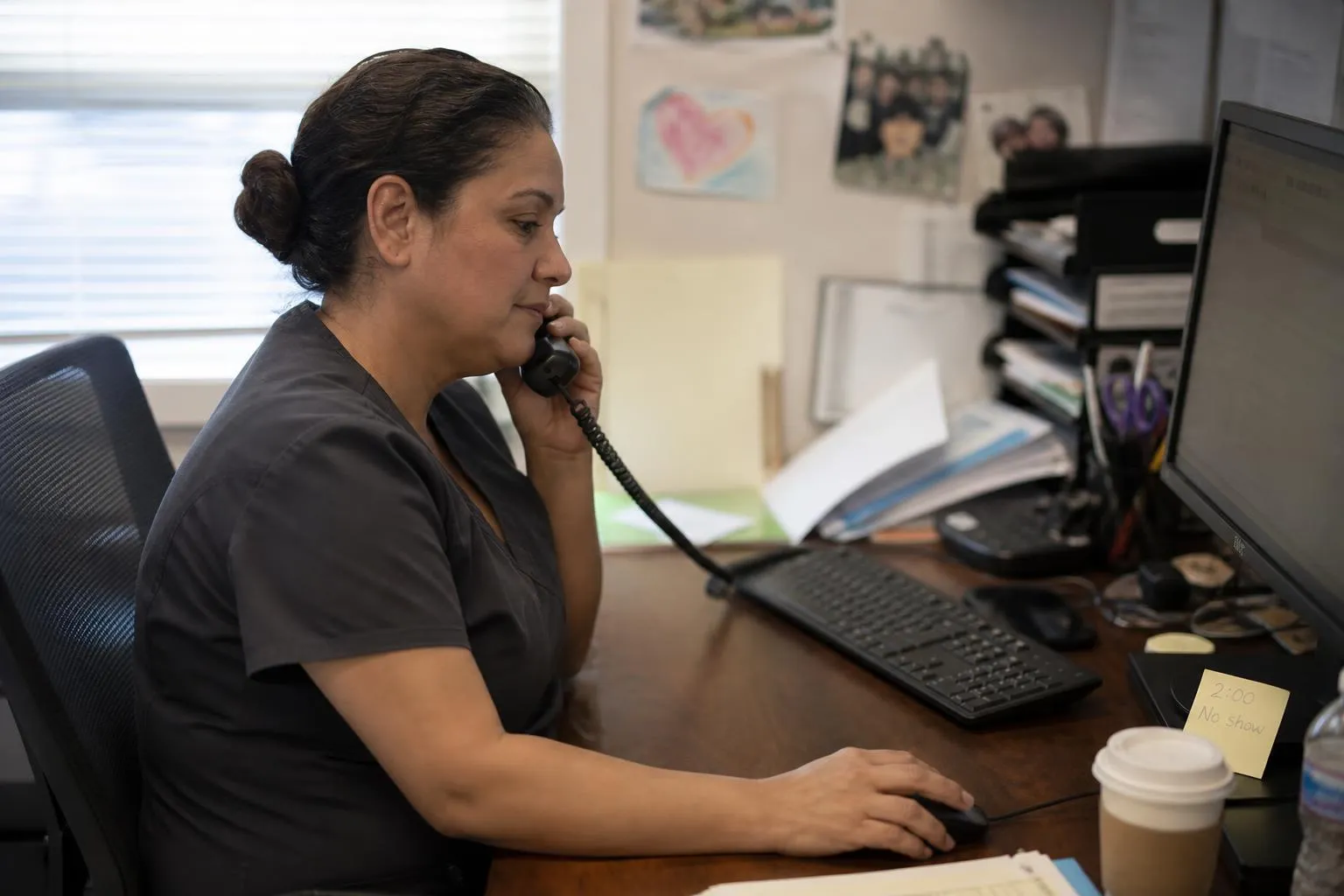
It also matches what patients ask for: 71% say more same-day or next-day availability would prevent their no-shows. Offering the open slot while the patient is already on the phone talking about the missed one is the closest a call workflow gets to that.
This is the kind of workflow Greetmate builds and runs: healthcare voice and SMS infrastructure, designed around the practice's own call flows on the platform. The workflow is built and tested before go-live. The trigger, the slot lookup, and the write-back are checked against the practice's own system, and what happens when a patient doesn't answer is part of the design, with retry timing and fallback messages in the configuration. Somebody guides the rollout from scoping through launch, the workflows connect to the systems the practice already runs, and leadership can see what came in and what it produced: outreach sent, rebooks completed, slots refilled. If you want to see the workflow mapped against your own schedule and EHR, a live walkthrough takes one call.
What this looks like in your EHR: trigger and booking support
Healthie, athenahealth, eClinicalWorks, and DrChrono all record a no-show status on the appointment. Where the four differ is on the automation side: how deep the API support goes for watching that status, how the slot lookup and the write-back are configured for a given setup, and whether both can run automatically during a live call.
That isn't something to take from a feature list. It gets confirmed during scoping, against the practice's own system, before anything goes live. If a step can't be confirmed for a particular setup, the workflow is designed around what that setup supports — for instance, reading the no-show status where the API allows it, falling back to a shared spreadsheet the front desk marks where it doesn't, or routing the patient's chosen time to staff when the write-back can't run during the call — and the practice knows exactly which version it's getting. Greetmate integrates with dozens of EHRs, so the front desk keeps working in the system it already uses and the recovery runs around it.
When you can't charge for a no-show, rebooking is the recovery
Before any fee policy, it helps to know where charging is even on the table. The short version: Medicare generally allows it under conditions, most Medicaid programs don't, and payer contracts get the final word. What follows is information, not legal advice. The rules vary by state and by contract, and the policy is the practice's to own.
Medicare: fees are allowed, with conditions
CMS permits no-show fees for Medicare patients, with one condition carrying most of the weight: the policy has to be applied without discrimination. The same policy and a similar fee have to apply to Medicare and non-Medicare patients alike (CMS Claims Processing Manual §30.3.13, summarized by Kaufman Dolowich). A fee charged only to Medicare patients, or only to everyone else, fails that test.
Medicaid: in most programs, the patient can't be billed
Most Medicaid programs prohibit billing patients for missed appointments, and several states (California, Florida, New York, and Texas among them) point to 42 CFR §447.15, the federal provision they cite as barring no-show fees. On a Medicaid-heavy panel, the fee lever is mostly off the table.
The AMA position, and the contract that governs
The AMA considers a no-show fee ethically acceptable when the patient gave less than 24 hours' notice, provided it is applied to all patients rather than some (Kaufman Dolowich). All of that sits underneath the payer contract. Before charging anyone a no-show fee, review what your contracts actually allow; contract review comes first.
Here is the connection the fee articles don't make. On a panel where the patient can't be billed, the no-show fee question is mostly academic: a bill doesn't refill the slot. The slot comes back one way: the patient rebooks. When fees are off the table, same-day rebooking is the whole recovery path, and every day without it is a slot gone.
The compliance line on automated outreach calls
Automated outreach calls are regulated under the TCPA, and the FCC's February 2024 Declaratory Ruling settled the question that matters here: AI voices are "artificial or prerecorded voice" under the statute (Retell AI's TCPA compliance summary). An AI outreach call falls under the same consent framework as any robocall, with statutory damages running $500 to $1,500 per call.
None of that is a reason to skip automated outreach. It's a design input. Who has consented to be called, on which number, and how an opt-out gets honored are workflow decisions made before launch, and the policy belongs to the practice. Where patient data moves through the workflow, Greetmate is HIPAA-ready, with a BAA available. As with the fee rules above, this is information, not legal advice: have counsel review the consent language before the first call goes out.
FAQ: no-show recovery and fee rules
Can you charge a Medicaid patient a no-show fee?
In most states, no. Most Medicaid programs prohibit billing patients for missed appointments, and several states cite 42 CFR §447.15 as the barrier (Kaufman Dolowich). Check your state's rules and your payer contracts before charging any Medicaid patient a no-show fee.
Can you charge Medicare patients a no-show fee?
Generally, yes, under conditions. CMS permits no-show fees if the policy is applied without discrimination: the same policy and a similar fee for Medicare and non-Medicare patients alike (Kaufman Dolowich). Your payer contracts still get the final word.
What no-show rate is normal?
The U.S. average runs about 18% to 23%, and it varies sharply by specialty: sleep medicine sits near 39%. Use that as context for the field. Your own number, tracked per provider and per location over a rolling 90 days, is the one worth managing.
Do no-show text messages work?
For prevention, yes. Reminders help, and self-scheduling is associated with 29% fewer no-shows. A reminder keeps a scheduled appointment on the books. It doesn't refill a slot after a miss. Recovery needs its own workflow, triggered by the no-show itself.
How quickly should you contact a no-show?
The same day. The slot can still be refilled, and the patient is reachable now. Same-day bookings account for about 2% of no-shows while appointments booked 15 or more days out account for roughly a third. Every day of delay pushes the rebook into the range where misses happen.
Every no-show is the start of a recovery workflow
The practices that handle no-shows well aren't the ones with the longest reminder cadence. They treat the no-show as the start of a recovery workflow: the flag triggers outreach the same day, the patient picks a real time during the call, and the appointment lands on the schedule before anyone hangs up. Prevention still matters. Recovery is what stops the misses you already have from becoming permanent.
That workflow is what Greetmate builds and supports. The workflows are built and tested before go-live, and somebody guides the rollout from scoping through launch. Everything connects to the systems the practice already runs, and leadership can see what came in and what it produced: outreach sent, rebooks completed, slots refilled, staff hours returned.
If no-shows are costing your practice slots every week, book a demo and see what same-day recovery would look like on your schedule, in your EHR.