Physician answering service: 5 checks before you sign
| Greetmate
Most practices pick a physician answering service the same way: one demo call, one quote, and a reassuring conversation about how many clinics the provider already covers. Then the contract starts, and the questions that decide whether the service actually works (what a message costs, who acts on it after it's taken, what happens when the on-call person doesn't pick up) were never put in writing.
The buying process is built to make that easy. Search results for these terms are almost entirely vendor-published, the standard "questions to ask" checklists cover things you can't verify, and nobody hands you a list of terms you can put in a contract.
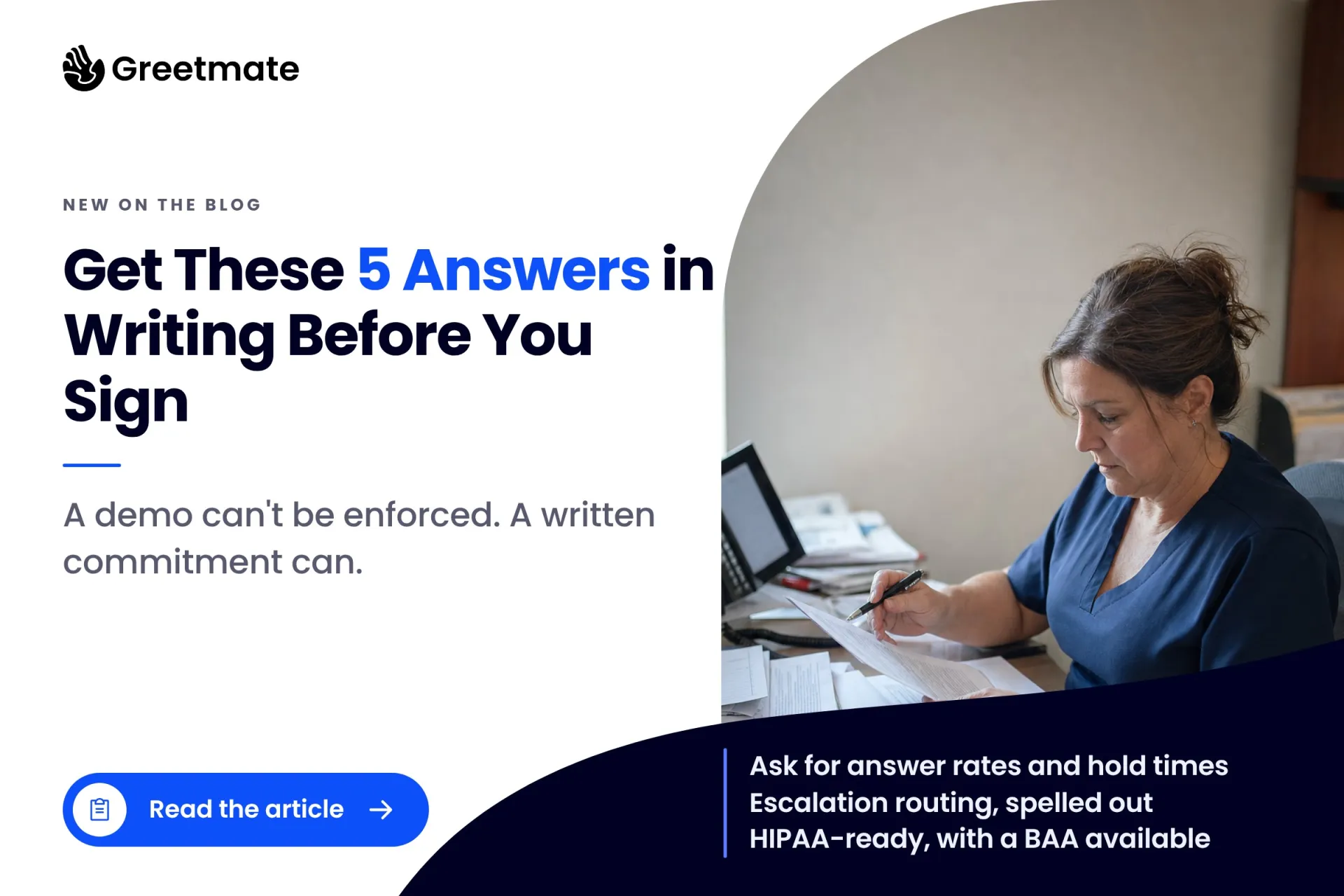
This post is that list: five checks, each ending in something a vendor can produce or commit to on paper before you sign. They cover billing, compliance, service levels, the handoff after the message, and the overnight escalation path. Forward it to whoever signs the contract; it's built to be used as evaluation criteria.
Table of Contents
What should you check before signing with a physician answering service?
Five things, each verifiable in writing before the contract starts:
How a "message taken" is billed, and what the average message costs at your call volume.
A signed BAA covering the operators who take your messages.
Average speed of answer and abandonment rate, reported monthly in the contract.
Who acts on each message, in which system, and how fast.
A written after-hours escalation path with timeouts and a fallback.
Each check below is a document, a number, or a commitment: something you can verify before you sign and hold a vendor to after.
Why most answering service checklists stay generic
Run the searches yourself: "physician answering service," "doctors answering service," "answering service for doctors office." The first page of each is mostly vendor homepages and "best of" listicles published by companies that sell into the category. The "questions to ask" articles that do exist ask about operator training, references, and demos. Reasonable questions, and none of them produce anything checkable. You can't audit training, references come from the vendor's happiest clients, and a demo call is a call the vendor placed at a time they chose.
What's missing from all of it: billing terms you can verify, service levels you can hold a vendor to, and any attention to what happens after a message is taken. That last one is where practices report the actual pain. The five checks below cover exactly that ground.
Check 1: How a "message taken" is actually billed
The first question is what counts as a billable event. Connect time? Wrap time, the minutes an operator spends writing up the call after hanging up? Or a completed action? These are different products at different prices, and quotes almost never say which one you're buying. A message taken is not a message delivered, and neither is a call resolved.
Per-minute billing has a quiet problem: it bills you the most for the calls that go worst. The confused caller, the one who calls back a third time to confirm details, is where the minutes pile up. The service struggles, and the invoice goes up.
Quotes in different units aren't comparable. A per-minute quote and a per-call quote can describe the same workload at very different monthly invoices, and the only way to compare them is the per-resolved-call math. We ran that math in full in Medical answering service cost in 2026, and the math most quotes hide. Read it before you put two quotes side by side.
Then ask the vendor for two numbers from existing medical clients: average message length, and average calls per message. A service that can't produce them is guessing at your invoice.
Check 2: BAA and HIPAA readiness, three things to ask for in writing
Search for a HIPAA answering service and every homepage says the same two words: "HIPAA compliant." That phrase isn't a certification, because nothing certifies it. It's a claim that the vendor handles patient information in a compliant way, and verifying the claim is your job. It comes down to three documents.
First, the BAA itself. Ask for it before you sign, not at onboarding. Then ask who it covers: the operators who take your messages, any subcontractors, and any offshore team. A BAA that covers the company but not the people reading your patients' messages is a partial document.
Second, message handling. Where messages are stored, how long they're kept, and who can pull the logs. If a message is ever lost or disputed, the log is the only record of what was said.
Third, the scripts. What operators are allowed to collect and what they're instructed to write down, reviewed against the BAA before go-live.
For reference when you compare options: Greetmate's own position is HIPAA-ready, with a BAA available.
Check 3: Get the numbers on hold times and abandonment, then put them in the contract
Asking "do you answer quickly?" produces a yes from every vendor. There are real benchmarks for what acceptable looks like in healthcare call handling, so ask for numbers instead.
Call abandonment rate: measured reality vs. benchmarks
So the question to ask is: what is your average speed of answer and your abandonment rate for medical clients, and will you report both monthly, in the contract? A vendor that answers "we answer fast" is telling you it doesn't know its own numbers.
Check 4: What happens after the message is taken
Almost every checklist on the market stops at who answers the phone. The pain practices report is what happens to the message afterward.
Ask where it lands. A message taken at 7 p.m. can arrive as a text to the on-call provider's personal phone, as a portal entry someone checks at 9 a.m., or as an email to a shared inbox. Those are three different products. Only one of them wakes anybody up.
Ask what the timeout is. If the on-call person doesn't acknowledge within fifteen minutes, does the message go to a second contact, or does it sit until morning? The answer to listen for is a named escalation path with a timeout and a fallback: who gets paged, in what order, and what happens when the first person doesn't pick up.
And ask for a handoff log. A message that was taken but never acted on should be visible to you as an operational failure (timestamped, countable) rather than absorbed into tomorrow morning's voicemail.
Check 5: After-hours escalation paths, tested before you need them
Escalation is where an answering service actually gets tested, and it's the part no demo shows you. A demo call placed on a Tuesday afternoon tells you nothing about a Saturday night.
Get the escalation tree in writing before you sign: which call types page the on-call person immediately, which hold for the morning, and what happens when the first person doesn't pick up. "Someone will get back to them" is a hope. A tree with names, timeouts, and a fallback is something you can manage.
Ask to see the script the operator will read overnight, and the questions they'll ask. If they can't produce it, they're improvising with your patients.
Then run one test before the contract starts counting. Have a staff member call after hours and trace what actually happened, end to end: who answered, what they asked, where the message landed, who acknowledged it, and when. One traced call tells you more than the whole sales process.
**If you forward one thing to the decision maker, forward this.** Before signing with any answering service, ask for:
Billing in writing — what counts as a billable event, and the average cost per message at your call volume
A signed BAA — before go-live, covering operators and subcontractors, with message retention and log access defined
Monthly numbers — average speed of answer and abandonment rate, written into the contract
A handoff owner — where each message lands, who acts on it, in which system, and how fast
An escalation tree — named contacts, timeouts, and a fallback when the first person doesn't pick up
</Callout>
A different model worth knowing about: AI voice infrastructure
Everything above applies to a traditional live-operator service. Most of it applies to AI voice infrastructure too, with one structural difference worth understanding before you build a shortlist.
A traditional service is a message-relay layer. A person takes the message, and everything after that depends on the escalation rules you wrote and on somebody checking a portal or an inbox. Greetmate is built as a workflow layer on top of call handling: the intake, routing, and follow-up steps are designed, tested, and connected to the systems the practice already runs before go-live. The routing, the timeout, the escalation to a human, and the logging are part of the workflow itself. The after-message loop doesn't depend on whoever checks the inbox first, and leadership can see what came in and what it produced.
The checklist above doesn't change. Ask any vendor, in any model, for the same five things in writing. If you want to see what that looks like answered concretely, Greetmate's platform page shows the workflow builder, the routing, and the reporting.
FAQ: physician answering service
How much does a physician answering service cost?
It depends entirely on how the service bills, which is why comparing quotes is harder than it looks. A per-minute quote and a per-call quote can describe the same workload at very different invoices, and neither tells you what one resolved message costs. The full math, including what most quotes leave out, is in Medical answering service cost in 2026, and the math most quotes hide.
Is an answering service HIPAA compliant?
No service "is" compliant as a status. Readiness shows up in documents: a BAA signed before go-live, coverage for the operators and any subcontractors, defined message retention, and logs you can pull. Ask for those in writing. If you're also evaluating AI-based options, we wrote about what HIPAA-compliant voice AI vendors won't tell you.
What's a good hold time and abandonment rate for a medical office?
Who is responsible when an answering service takes a message?
The operators are nonclinical message-relay staff, and clinical responsibility stays with the practice, the standard division of labor in after-hours coverage. That's also why the escalation rules and the handoff log matter: the service's job is to reach the right person in your organization with the message intact.
What should I ask an answering service before signing?
The five checks, compressed: how a message is billed and what it costs at your volume; a BAA covering the operators; monthly hold-time and abandonment reporting; who acts on each message and how fast; and a written escalation path with timeouts and a fallback. A vendor that can't answer all five in writing has answered you.
Before you sign
Every check on this list comes down to the same move: get it in writing before the contract starts. The billing terms, the BAA, the service levels, the handoff owner, the escalation tree. The category's marketing is built around "we answer your phones," and most services do answer. The practices that get value from these contracts are the ones that bought the answering part and the handoff part together.
If you're building a shortlist, book a demo and bring this checklist with you. See how a workflow-based deployment answers each of the five questions, and hold every other vendor on your list to the same page.
AI Voice Infrastructure for Healthcare
Automate Your Clinic's Phone Operations.
Reduce front-desk call volume and improve patient communication. Go live in hours with done-for-you setup.
Inbound call handling, after-hours coverage, and overflow management.
Appointment scheduling, patient follow-up, and reactivation workflows.
Workflow-driven call logic with EHR and system integrations.
Built for multi-location healthcare groups and partner networks.
Disclaimer: This article is for informational purposes only and does not constitute legal or compliance advice. Consult a qualified professional about HIPAA obligations and contract terms for your organization. Any pricing or benchmark figures referenced are examples as of the date of writing — verify current terms directly with any vendor you evaluate.
More Blog Articles
Find helpful articles in our blog that are all about business, customer service and AI technology.
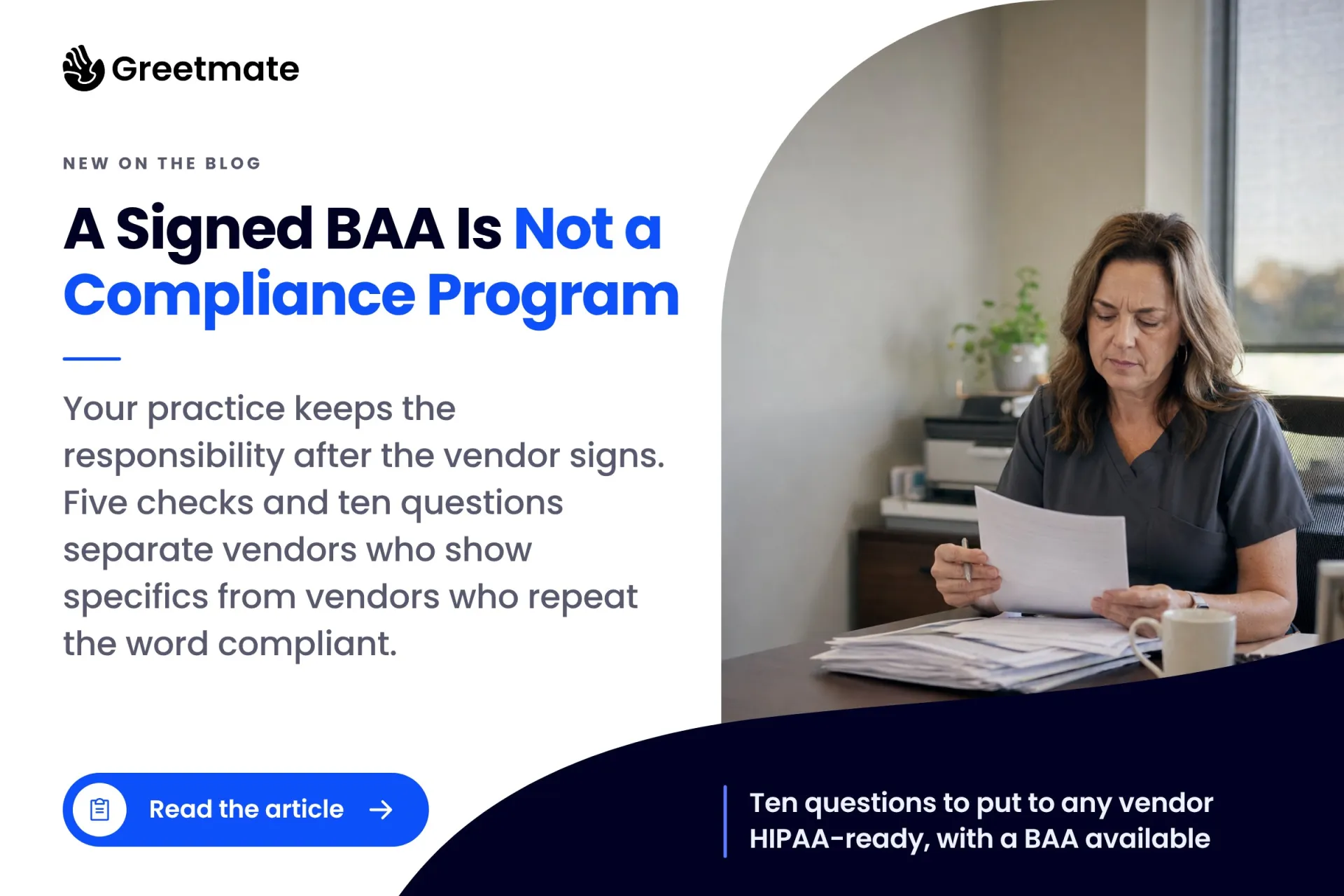
Your practice keeps the compliance responsibility even after the vendor signs. A five-point checklist and ten questions that separate vendors that can show you specifics from vendors that repeat the word compliant.
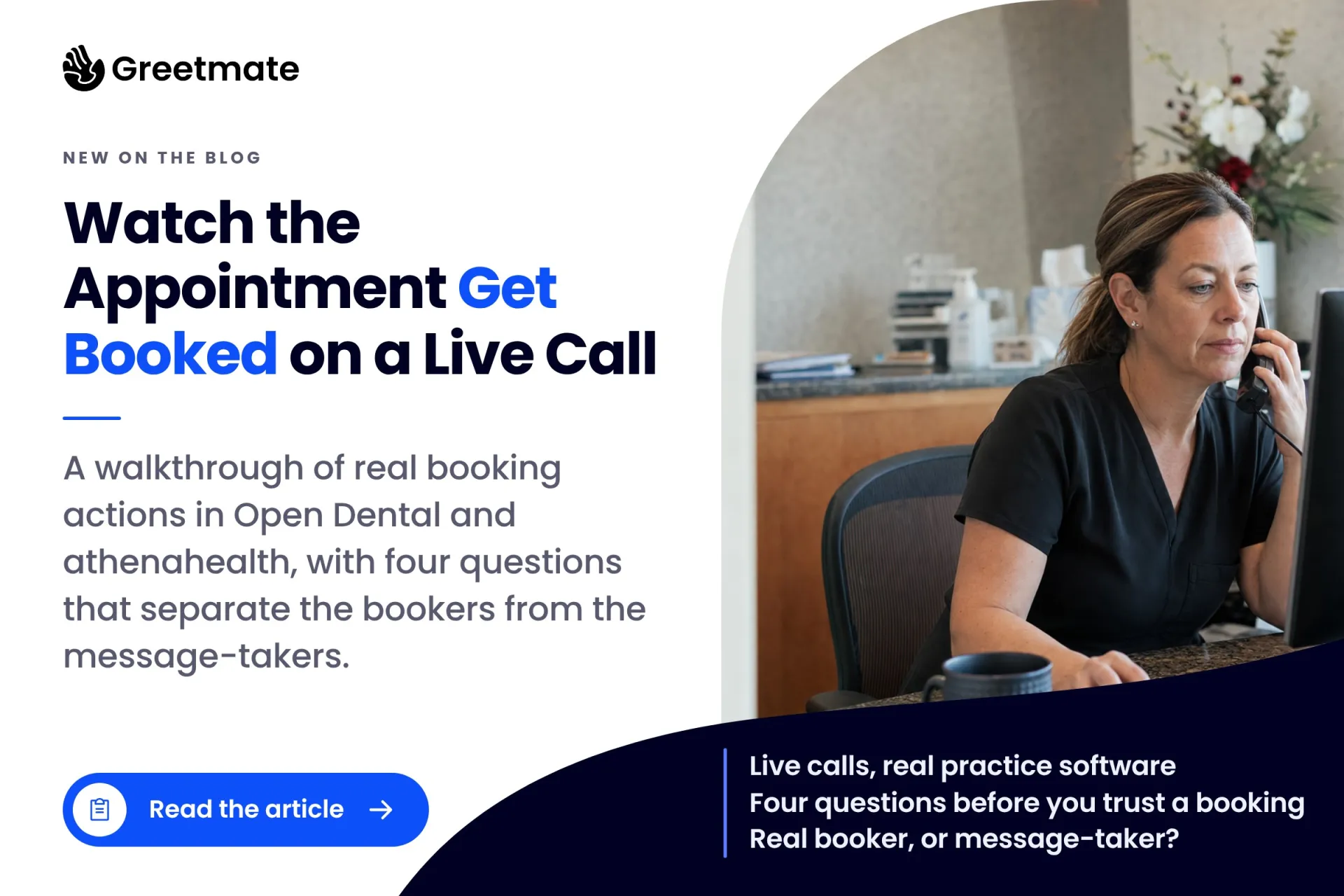
A live-call walkthrough of real Open Dental and athenahealth booking actions, with a four-question checklist that separates real bookers from message-takers.