Speed to Lead for Medical Practices: The 5-Minute Call
Healthcare has the slowest lead response time of any industry. Here is the trigger-by-trigger workflow that calls every new patient inquiry back inside five minutes and books in the same call.
| Greetmate

A chiropractic answering service is usually sold on a single promise: somebody picks up. That is the easy half of the job. In a practice where patients are booked twice a week for six weeks, the phone rings while the front desk is walking one patient into a treatment room, checking in the next, or sitting on hold with an insurer. The call that goes to voicemail is a 7 a.m. cancellation for a slot that will now sit empty all morning.
The bottleneck is not the staff, it is the line. One person can hold one conversation, and three people can call at once, which is why front desk overload keeps showing up as a limit on practice growth long before staffing does.
The useful way to think about coverage, then, is by call type rather than by hours of the day. In a weekly-visit specialty the traffic breaks into reschedule and cancellation churn, new-patient enquiries that get decided the same day, insurance and plan-of-care questions, and calls where the right answer is a person on the line. What follows is a coverage design for each, a written escalation path for that last case, and a published list of what should never be automated on a clinical line.
Key Takeaways:
Table of Contents
A primary care patient might be seen twice a year. A chiropractic, PT or MSK patient may be on the schedule twelve to twenty-four times over six or eight weeks. Each of those visits is another chance to cancel, reschedule, forget, or drift off the plan of care without telling anyone. The churn comes from the sheer volume of appointments.
The data supports that reading. In the largest US study of no-shows in musculoskeletal physical therapy, 73% of patients missed at least one appointment, and no-show rates ranged from 15% to 31% depending on clinic, provider and state. The authors attribute the elevated rate versus other specialties to the condensed schedule of repeated visits over a short window.
A national survey of 634 US outpatient physical therapy clinics put the mean no-show rate at 10.4%, and the single most common reason patients gave was simply that they forgot. A peer-reviewed case study across 6,162 scheduled appointments found a combined no-show and cancellation rate of 20.6%, highest among patients aged 12–20 (31.4%) and 21–30 (31.3%), with the top reasons being forgot, a family or personal conflict, transportation, and scheduling conflict.
The effect runs past the calendar. In a qualitative study of why patients did not follow the plan of care after their initial evaluation, access issues were the single largest theme at 26.9%. When a patient cannot reach the clinic to move a visit, sometimes they do not move it. They stop coming.
A generic answering service is built to get the phone answered. A practice that books a patient twelve to twenty-four times per plan of care also needs the schedule defended, and that is a different job.
The practices this fits are the ones where the phone has become the constraint: roughly 2 to 20 providers, 30 or more calls a day, and a schedule dense enough that a single unfilled morning slot is money. Below that call volume, a well-run front desk usually absorbs the traffic without help. Above 20 providers, the problem shifts from coverage to standardizing coverage across sites.
An answering service for chiropractors, PT clinics and mental health practices handles four distinct call types: reschedules and cancellations that churn the schedule daily, new-patient enquiries that are decided within hours, insurance and plan-of-care questions that need a person with account access, and calls that must reach a human immediately.
Separate the traffic before designing the coverage. Each of those four needs different handling, different escalation and a different measure of success, which is why one script applied to all of them underperforms.
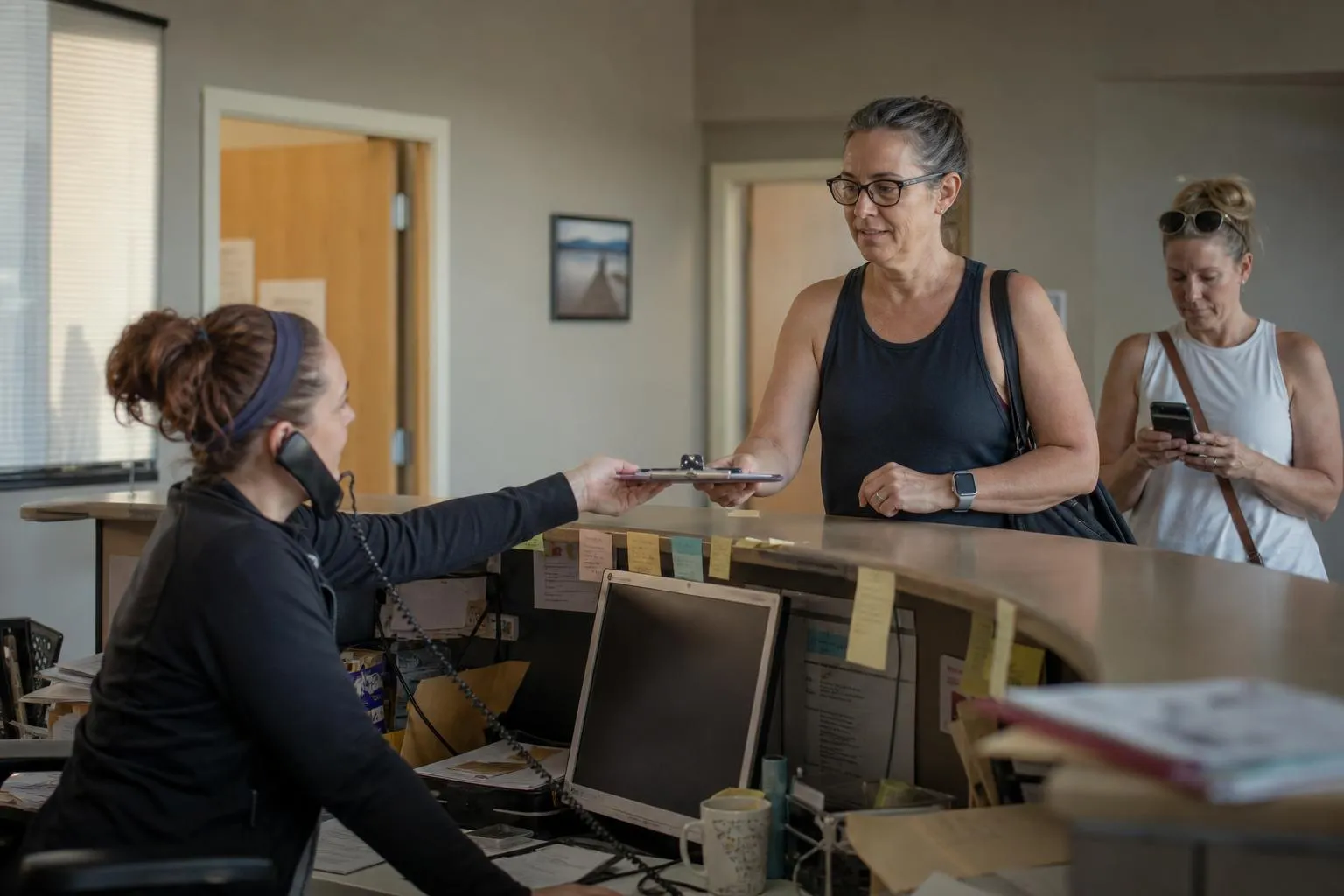
A patient calls at 7:12 a.m. to cancel a 9:00 a.m. adjustment, and nobody is at the desk yet. The voicemail gets heard at 8:45. By then the slot is dead, and the clinic has lost an hour of provider time it already paid for.
Answering that call is the first of six steps. The loop that recovers the revenue runs like this:
Steps 3 through 6 are where the competing sales pages go quiet. A message taker hands your team a note. A workflow connected to your scheduling system can move the appointment, text the waitlist and confirm the replacement before the first patient of the day walks in.
The upstream half of this is reminder design, and it is measurable. In that same national survey of outpatient PT clinics, practices using a multi-method reminder system together with a 24-hour cancellation-notice requirement reported a 6.07% no-show rate, versus 13.80% for clinics relying on phone-call reminders alone.
Reported no-show rate by reminder design (US outpatient PT clinics)
Two things follow. Send reminders on more than one channel, since "forgot" is the leading reason people miss. And make cancelling easy on purpose: a patient who can cancel at 7 a.m. without a fight gives you two hours to refill the slot, which is worth far more than a no-show you find out about at 9:01.
The acquisition call behaves nothing like the reschedule call. Somebody is working down a list of three clinics. A parent is calling about an orthodontic consult between meetings. Someone finally decided to look for a therapist and is dialling.
None of them are shopping for weeks. They are deciding now, and the practice that answers and books usually gets them. We put numbers on that in the ROI of faster patient response times. A voicemail returned at 11 a.m. the next morning is competing against a clinic that already put the caller on a calendar.
In behavioral health, the access gap is wider still. A mystery-shopper study across five US states found a median wait of 67 days for an in-person general psychiatric visit and 43 days for telepsychiatry, and cites prior research linking long waits to patients not attending the first appointment at all. A peer-reviewed adolescent mental-health study found a mean wait of 11.8 days among appointments actually offered, and found that reaching the practice at all, plus directory accuracy, were failure points in their own right. If the line does not get answered, the practice is functionally not in the network.
Coverage for this call type should collect the reason for the call, referral source, insurance carrier, contact details and preferred times, then book into the first genuinely available slot. It should not promise a callback for something it can complete. A confirmation text with the appointment details goes out on the same call, and the intake summary lands in the systems your team already opens each morning.
This is the call that eats the most front-desk minutes, and the one a message taker can do least with. "How many visits do I have left?" "Did my authorization go through?" "Is the acupuncture covered under my plan?" A note that says patient called about insurance, please call back creates work rather than removing it.
There is a clean line here between capture and answer.
A workflow should confirm which carrier the patient has, capture the member ID and the specific question in the patient's own words, note the visit count on file where the workflow has read access to it, and route the item to the right person with a complete summary, so staff act once instead of playing phone tag across three calls.
It should never quote coverage, estimate what the patient will owe, interpret an authorization decision, or say whether a treatment is appropriate. Those answers require a human with account access and, in the clinical case, a clinician. One national competitor states plainly on its own site that its agents do not give medical advice or discuss treatment. That is a reasonable limit, and it is one to design around rather than sell as a feature.
Anything touching patient information needs the compliance basics settled before launch: a signed BAA, defined data handling, and workflows that only touch the fields they need. Greetmate is HIPAA-ready with a BAA available, and access is scoped to what each workflow actually requires.
Reduce front-desk call volume and improve patient communication.
Go live in hours with done-for-you setup.
This part of a mental health answering service deserves more than a bullet point. On a call your clinical lead has flagged as needing immediate human attention, and on any call where the caller simply asks for a person, an automated workflow has one job: stop the flow and put the caller in front of a human through a path that was written and signed off before go-live.
It should not evaluate anything about the caller. That is a trained-human function. The workflow recognises a hand-off condition your clinical leadership defined in advance and transfers, and nothing beyond that.
Writing the path down beats improvising, because improvising produces inconsistent outcomes and no record of what happened. Routing invented on the spot at 11 p.m. is not a policy, and nobody can review it the next morning.
The design argument behind those rules is straightforward. Loosely-guided conversational AI drifts off-script, and on a clinical line that drift is the entire risk. A structured workflow with predictable routing logic is what belongs on this call. Give the workflow the least authority it needs to do its job. Here, that authority is recognise and transfer.
Disclaimer: This section describes operational call-routing design only. It is not clinical guidance and does not describe how to evaluate or manage any clinical situation. Clinical protocols are set by qualified clinicians in your organization, and the routing simply executes what they decide.
Most after-hours behavioral health calls are routine. They are people who finally decided to act, at an hour when nobody is at the desk.
Inclusive Therapy Group, a Greetmate customer, saw that pattern in the numbers. Across 836 calls handled, 68% came in after hours. 501 callers were helped immediately, average call length was 72 seconds, 217 callbacks were eliminated, 33% of calls were resolved at first contact, and the team recovered about 69.5 hours of staff time.
Cub Larkin, Founder & Clinical Director at Inclusive Therapy Group, describes the pattern this way:
"Many callers reach out after-hours for privacy, work-schedule reasons, or because they are finally ready to take action."
He is also clear about what the coverage was for:
"Our intent was not to replace staff. Our intent was to extend responsiveness."
The same shape shows up at On Your Mind Counseling, another Greetmate customer, where 520 calls ran 73% after hours, with 357 voicemails avoided, 41% resolved at first contact and roughly 60.7 hours of hold time removed from patients' lives.
Getting the first appointment onto the calendar matters commercially, because early drop-off in mental health care is common. Estimates of early treatment discontinuation sit at 22.4% in the NCS-R and around 30% in WHO data. And for groups with Medicaid managed care contracts, this is now being measured externally: CMS appointment wait-time standards cover outpatient mental health and SUD services, and are enforced through secret-shopper surveys at a 90% compliance rate. Under those surveys, somebody really is calling your line to see whether it gets answered.
An orthodontic answering service has a different rhythm again. Treatment runs 18 to 30 months, with adjustment and aligner-check visits stacked across it, so the reschedule volume stays steady for years rather than weeks. The person on the phone is usually a parent, not the patient. Visits collide with school hours, so the acceptable slots are narrow, and treatment-fee and payment-plan questions come up constantly.
The coverage design follows from that. Handle reschedules and confirmations end to end, including the backfill loop above, because a repair appointment and an aligner check are not interchangeable in the calendar. Capture which parent or guardian is calling and which patient they are calling about. Route fee, contract and payment-plan conversations to the treatment coordinator with a full note, and never quote a number on an automated call. For groups running both ortho and general dentistry, the dental coverage design applies to the same front desk.
Publishing the limits is more useful than pretending there are none. This is the list we hold to.
That last rule is the honest answer to the "patients want a real person" objection. They do, so design for it and let automation take the traffic that never needed a person in the first place.
Once you have more than one location, the patient experience starts depending on which desk happened to pick up. One site rebooks cancellations onto the waitlist; another writes them on a sticky note. One site transfers a caller who asks for a person in fifteen seconds; another takes a message.
Standardising that is an implementation problem rather than a feature problem, which is where the delivery model matters. Greetmate scopes each workflow with the practice, builds it, connects it to the scheduling system and EHR already in use, tests it against real call scenarios, then supports the launch. Basic deployments are often live within hours. Greetmate integrates with dozens of EHRs and scheduling systems, so staff keep working where they already work.
Leadership then needs to see the output. In a weekly-visit specialty, the reporting cuts that matter are specific:
That is what turns phone coverage into something you can manage. If the Tuesday 7–9 a.m. window produces four cancellations a week at one site and one at another, you can act on that. Groups running the same design across sites can see it in one view, which is the approach behind our work with multi-location groups and PT, OT and MSK practices.
Four call types, each needing different handling: reschedules and cancellations that churn the schedule daily, new-patient enquiries decided within hours, insurance and visit-authorization questions that need a person with account access, and calls requiring immediate escalation to a human. Coverage designed around all four beats a single script applied to everything.
Roughly 2 to 20 providers handling 30 or more calls a day. That is the point where the phone line itself becomes the limit rather than the size of the front desk team, and where a designed coverage model pays for itself against the slots it recovers.
No. On those calls a workflow's job is to recognise the hand-off condition your clinical lead defined in advance, stop, and transfer to a human immediately through a documented path with a named fallback. Any evaluation of the caller is a trained-human function. Write and approve that path before go-live, and re-test it whenever the on-call rotation changes.
Capture the cancellation live, rebook the caller on the same call, release the slot in the scheduling system, text every eligible waitlisted patient at once, book whoever replies first, and notify the front desk of the resolved slot. Speed decides the outcome: a 7 a.m. cancellation heard at 8:45 is usually unrecoverable.
Yes, when it is integrated properly. Greetmate connects to dozens of EHRs and scheduling systems, so bookings, reschedules and intake details land where your team already works. That integration and testing happens during implementation, before launch, so nobody is copying appointment details by hand afterwards.
It depends entirely on what the service actually does. Bottom-of-market services advertise $25–$100/mo, which buys message taking. Workflow-based coverage that books, reschedules, backfills a cancelled slot and escalates to a person on demand is a different category of spend, and the right way to compare the two is cost per resolved call rather than cost per month. We broke that down properly in medical answering service cost in 2026.
Twenty appointments per patient means twenty chances to cancel, and a front desk already halfway into a treatment room cannot be the only line of defence.
So design coverage per call type. Absorb the churn and backfill the slot the same morning. Close the new-patient enquiry inside the decision window instead of promising a callback. Capture insurance questions with enough structure that staff act once. Write the hand-off path for the calls that need a person, get it signed off, test it, and publish the limits so patients and staff both know where automation stops.
Greetmate builds and tests those workflows against your own scheduling system before go-live, guides the rollout, and shows leadership what came in and what it produced. HIPAA-ready with a BAA available, and recognised in the 2025 Globee® Awards for AI and the 2025 Titan Awards IT — AI & Automation.
Schedule a demo and we will map your four call types against your current coverage.
Handle patient calls around the clock — including after-hours and overflow — so your front desk can focus on in-office care.
Automate appointment scheduling, patient follow-ups, and reactivation outreach through workflow-driven voice communication.
Connect with your existing EHR, scheduling tools, and operational systems for seamless, end-to-end patient communication.
See Greetmate in Action.
Healthcare voice AI infrastructure — live in hours.
Find helpful articles in our blog that are all about business, customer service and AI technology.
Healthcare has the slowest lead response time of any industry. Here is the trigger-by-trigger workflow that calls every new patient inquiry back inside five minutes and books in the same call.
Seven retention motions, each with the workflow behind it: a list, a trigger, an outbound call or text, and a write-back. Reactivation, recall, no-show recovery, follow-up completion, feedback capture, and interval reminders, all running on schedules instead of staff willpower.